By the Expat Gate editorial team · As of 1 November 2026 · Creative relocation stories. The family's story is based on their own account; the residence rules are checked against the official pages of the Dutch Immigration and Naturalisation Service. This is not legal advice.
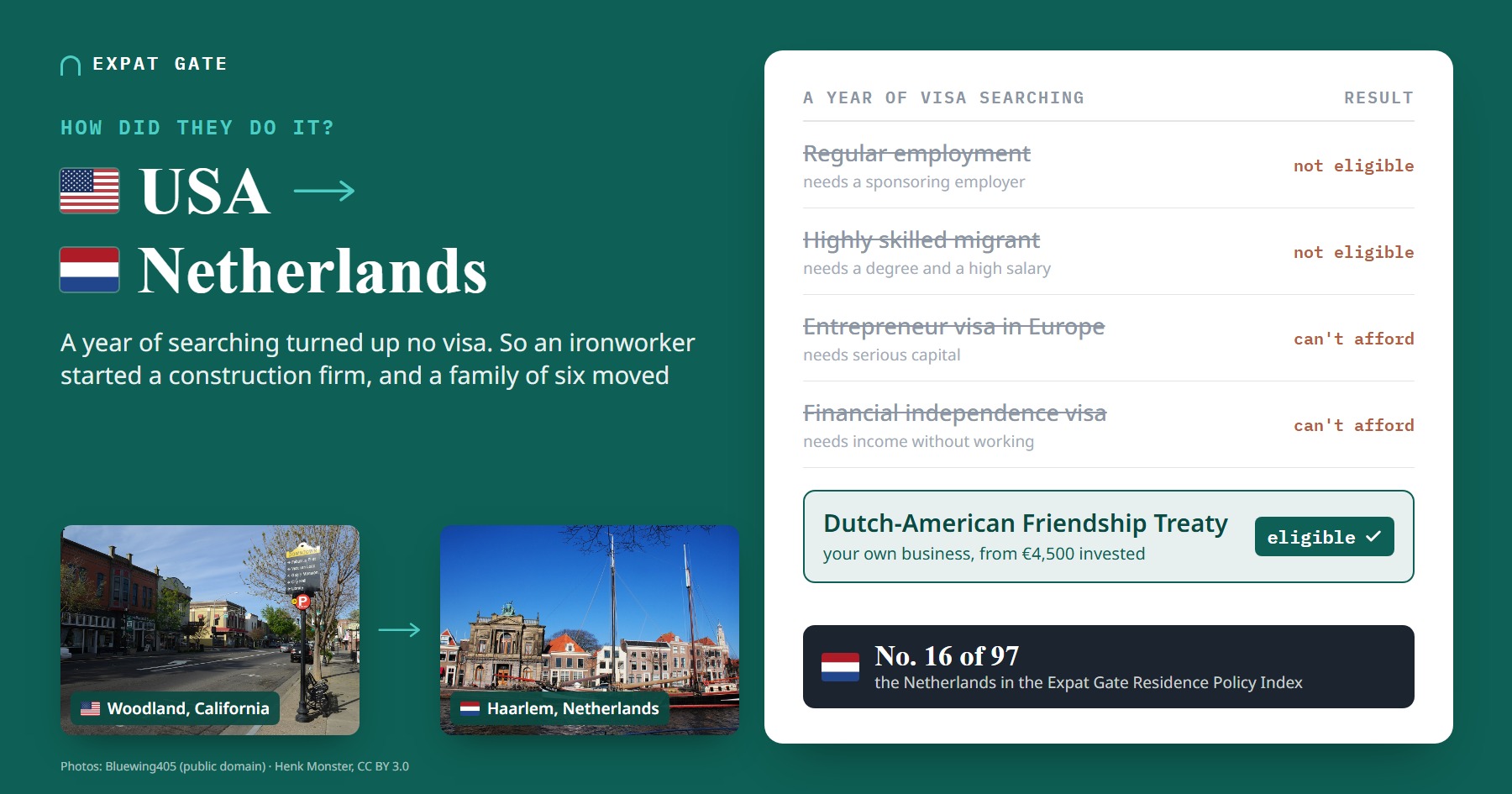
Short answer. The Hanchett family moved from the USA to the Netherlands under the Dutch-American Friendship Treaty: a US citizen can get a residence permit by starting a business in the Netherlands and investing at least €4,500 in it. This route is open only to citizens of the USA and Japan. Everyone else has other options: an orientation year for graduates of top universities, a job with a recognised employer, a start-up visa, or a business that is new to the country.
Why did they want Europe? So their kids wouldn't have it worse than they did
Janelle Hanchett is a writer and editor from California and a mother of four. At some point she realised her children's lives in America would probably be harder than her own, and that the political system, as she puts it, was sliding downhill with no hope of change. Then tragedy hit the family: after a family dinner, a mentally ill cousin attacked her grandmother with a knife. Whatever sense she had left that home was safe and the future was secure was gone. She tells the whole story herself on her blog.
A trip to France and Spain showed her that life could be calmer, without the constant pressure. That's how the goal appeared: move to Europe.
Why didn't it work straight away? The family didn't qualify for a single visa
For a full year Janelle kept a spreadsheet: countries, visas, requirements, costs. Every row ended the same way: either we don't qualify, or we can't afford it. Her editing income wasn't enough for a family of six. Her husband Mac had worked on his parents' ranch, spent more than ten years as an ironworker and had never run a business of his own. Neither of them fit the skilled-worker visas that European employers sponsor.
What did they find? A treaty few people have heard of
The tip came by chance. At a Christmas party, friends who had recently moved to Amsterdam asked whether they had heard of the Dutch-American Friendship Treaty.
It was signed 70 years ago and it still works. Under it, a US citizen can move to the Netherlands by starting a business there and putting at least €4,500 into it. No points test, no need to prove the country needs your business, and no separate income requirement for family members.
When the first lawyer said they qualified, Janelle didn't believe him: it sounded too good to be true. The second, with twenty years of practice, said he had never seen this visa refused. Then she believed it.
How did it become a plan? Her husband started a business he had never had
The lawyers accepted her editing work as a business. It couldn't feed six people, so they decided Mac would start a construction company: the Netherlands needed builders. He described his state of mind like this: "I'm so far out of my comfort zone that I'm not even scared anymore."
After that, it all came down to money. The family sold their house, which had gone up in value by about $80,000 while they owned it. Around €10,000 went on fees and lawyers, €6,000 on a shipping container, and about €20,000 was set aside as a cushion for a year in case the business didn't take off. There was one more condition that kept them on their toes: you can't ask the state for welfare benefits, or you risk losing your residence permit.
Seven months passed between the party where they first heard about the treaty and the flight to the Netherlands.
How did it go? Harder than they planned
With no local credit history and no contracts, nobody wanted to rent to them. One agency agreed on condition that they paid a full year's rent upfront, plus a three-month deposit and fees. That came to about €40,000, roughly half of everything they had. Later, the house was declared unfit to live in because of a gas leak, which explained the constant headaches the whole family had been having.
Mac's first job was an extension for the neighbours. He quoted €14,000 for work that was really worth €60,000-80,000. He lost money on it, but the neighbours told everyone they knew about him. Since then Mac has never gone more than a week without work, and his prices have long since become normal.
The kids, Janelle says, have thrived: school, healthcare and a kind of freedom they wouldn't have had in America. It was hardest on her. There was loneliness, depression, years without friends, and she spent her father's last years far away from him. Still, she doesn't regret the move: "We messed up a lot of things, but we got that right."
What did they actually do? They rebuilt themselves around the visa
The family stopped looking for a visa that fit the life they had, and rebuilt their life around the visa that existed: the husband's profession, their home and all their savings.
What if your passport isn't American? Then this route is closed
The treaty only works for US citizens. Japan has a similar agreement, and that's the whole list. Americans use it actively: 1,090 of these permits were approved in 2025.
For everyone else, Mac's construction company wouldn't have passed. Under the general rules, a foreigner's business is scored on experience, the business plan and its value to the Dutch economy, and the key condition is that the product or service must be new to the Netherlands. An ordinary building firm or an editing business doesn't meet that bar.
So how does everyone else get to the Netherlands? There are several routes, and one of them almost nobody knows about
An orientation year for graduates of top universities. If you hold a master's degree or a PhD from a university ranked in the top 200 of at least two of the three world rankings (Times Higher Education, QS and ShanghaiRanking), the Netherlands gives you a one-year residence permit. You have to apply within three years of graduating. Throughout that year you can work anywhere without a work permit, including for yourself. And an employer who hires you after that year only has to pay you from €3,122 a month instead of the usual €4,357-5,942.
A job through an employer. The classic route for a highly skilled migrant: the company has to be on the register of recognised sponsors, and the salary is currently at least €5,942 a month before tax if you are 30 or older, and at least €4,357 if you are younger. The most predictable option, but the employer decides here, not you.
A start-up visa. One year to launch an innovative project, but only together with a mentor (facilitator) from the official list of the Netherlands Enterprise Agency and under a signed agreement with them. The product has to be new to the country, you have to show enough money to live on for the whole year upfront, and this residence permit cannot be extended. After the year you can apply for the regular self-employed permit, if your business meets its conditions.
Your own business. Only if it is genuinely new to the country, otherwise you won't pass the points test.
How does it end? Every move has its own price
The Hanchetts paid for their Europe with a sold house, half their savings on housing alone and several lonely years. People without an American passport will pay in a different currency: a degree from the right university, a salary an employer is willing to offer, or years of preparation.
Where does the Netherlands rank in the Expat Gate Residence Policy Index?
The Netherlands: No. 16 of 97.
Sources
- Janelle Hanchett, "The whole story of how we moved to The Netherlands" - the family's story, amounts, timelines, quotes
- Immigration and Naturalisation Service (IND), residence permit for self-employed persons - the treaties with the USA and Japan, the €4,500 investment, points and the novelty requirement for everyone else
- IND, orientation year for highly educated persons
- IND, highly skilled migrant and the register of recognised sponsors
- IND, start-up
- IND, 2026 salary thresholds
- Fragomen, "The Dutch-American Friendship Treaty at 70" - 1,090 permits approved in 2025, no income requirement for family members
Checked by the Expat Gate editorial team on 1 November 2026.