Checked on 13 September 2026. An analysis of the law and the application procedure, not a promise of “zero taxes for everyone”.
Whatever we think of Turkey, we have to admit it is a strong move. Offering new residents twenty years of exemption from income tax on foreign income is a way to get onto the shortlist of countries to move to.
It sounds almost too good. You live by the sea, money comes in from abroad, income tax is zero. That is exactly how the news is easy to retell on social media.
But there is a big difference between “the money came from abroad” and “the income is treated as earned outside Turkey”. For someone with foreign dividends, this may be an excellent opportunity. For a freelancer with a laptop in Antalya, it is a question that cannot be decided by a headline.
Let’s go through what was actually adopted, who the relief is for and what to check before you move.
Short answer. The relief is real: if the conditions are met, an individual’s foreign-source income is exempt from Turkish income tax for 20 years. But it is not automatic: you need to obtain a special exemption certificate and apply on time. Turkish income stays outside this relief, and a foreign client does not by itself turn earnings into foreign-source income. The basis is Article 20/D and the procedure for applying it.
What exactly Turkey adopted
This is not a digital nomad visa or an agency’s promotional programme. Law No. 7582 added a special article to the Turkish Income Tax Law: mükerrer 20/D.
Three dates, so you don’t get confused:
- 4 June 2026: the law was published and the relevant provision entered into force.
- 1 January 2026: the date from which new residents can fall under the relief. So moving before the June publication does not by itself rule out participation.
- 4 July 2026: the final implementation procedure was published, Communiqué No. 333. That is where the important details of the application process appeared.
The entry-into-force and application dates are confirmed by KPMG. The July document can be read in the LEXPERA legal database.
This is an exemption from a specific tax, not the abolition of the whole tax system. Under Article 20/D, an individual’s qualifying foreign-source income is not taxed. Corporate taxes, taxes on Turkish income and any other possible obligations need to be checked separately.
Who the relief is for: four conditions
1. You become resident under Turkish tax rules
On the date of the application, the person must be regarded as settled in Turkey: Türkiye’de yerleşmiş sayılan.
The official guide names two grounds: a domicile in Turkey, or a continuous stay of more than six months within a calendar year. Temporary trips abroad do not reset this period. But this is the general framework: exceptions and international agreements can change the assessment of a specific case. Source: the GİB guide, section 3.
Don’t confuse three things: the right to live in the country, the right to work and tax residence. Getting the tax relief does not replace arranging legal residence and, where required, a work permit.
2. The previous three calendar years pass the test
The wording is stricter than “I haven’t been a tax resident for three years”. The law requires the absence of domicile and tax liability in Turkey in the previous three calendar years, with specific exceptions for certain types of income.
For someone who becomes resident in 2026, the years checked are 2023, 2024 and 2025. Not the last 36 months counted back from the day you arrive.
There is an important concession: previous Turkish income from real estate, capital or capital gains does not by itself block access to the relief, provided the other conditions are met. But a previous salary or business activity in Turkey is a different story. This is covered directly in Communiqué No. 333, Article 3, examples 5–7.
“I didn’t declare anything” does not mean “I had no tax liability”. The tax office may discover past activity later. The document includes an example where this leads to the exemption certificate being cancelled and additional tax being assessed.
3. The income is genuinely foreign-source
This is the central question. Not the currency of the transfer, not the country of the bank and not the client’s nationality, but the tax classification of the income itself.
4. You apply on time and obtain the exemption certificate
You can’t simply move and declare a twenty-year tax holiday for yourself. You need a document from the competent tax office: the İstisna Belgesi. Missing the application deadline can cost you the relief even if you meet all the other requirements. Vialto Partners places particular emphasis on this.
The main table: which income falls under the exemption
Everything below assumes that the person meets the conditions and has obtained the exemption certificate. The table concerns Article 20/D specifically, not every possible tax relief in Turkey.
| Your income | What happens with the relief | What to check |
|---|---|---|
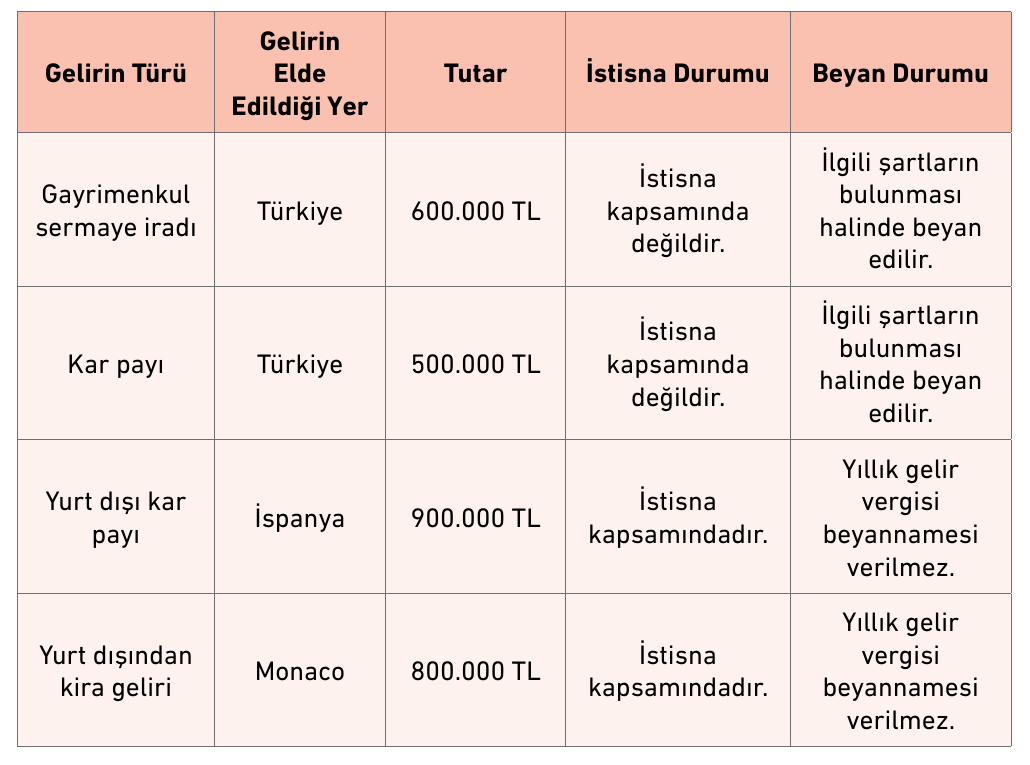
| Dividends from a genuinely foreign company | Foreign dividends are shown directly as exempt in an official example | The company’s status and the nature of the payment. If you manage the company from Turkey, check separately the consequences for the company itself |
| Rent from property outside Turkey | Foreign rental income is shown directly as exempt | Where the property is located and which taxes still apply in the country where it is |
| Rent from a flat in Turkey or dividends from a Turkish company | Do not fall under Article 20/D | The ordinary Turkish rules, withholding and whether a tax return is required |
| Consulting services for a foreign client, provided in Turkey, on the client’s Turkish investments | The Communiqué contains a direct example: no exemption | Where the activity takes place and what it consists of, not just the client’s address |
| Remote salary, freelancing, development or online services that you perform from Turkey | Cannot automatically be treated as exempt | Type of contract, place of work, source of income, other applicable rules and agreements |
The first four rows are based on the official text of Communiqué No. 333, examples 9–11. The last one is a cautious conclusion drawn from the distinction between foreign and Turkish income, not a promise of a universal rate for remote workers. The general rules on salaries and activities in Turkey are explained by PwC.
Why “foreign client = zero tax” doesn’t work
Imagine: you live in Izmir, work every day from your home office, and your client is in Berlin. Payment arrives in euros in a foreign account.
In everyday conversation, that is “foreign income”. For tax analysis, there is not yet enough information. You need to understand what exactly you receive: a salary, income from independent services, business profit or dividends.
Turkish law contains rules that link the source of salary and professional income to work being performed in Turkey. Article 7 formally deals with the limited tax liability of non-residents; on its own it does not replace an individual analysis of the new relief. But it shows clearly why the payer’s location is not the only criterion. Text of Article 7.
And the July Communiqué contains an even clearer case: an engineer works in Turkey and advises foreign clients on investments in Turkey. There are foreign clients. There is no exemption under 20/D.
So I would not move on the calculation “my freelancing is now definitely taxed at a zero rate” without a written opinion on the specific working arrangement. An adviser’s references should lead to provisions of the law, not to another adviser’s post.
This does not mean that all remote earnings are necessarily taxed in the same way. Other exemptions or deductions may exist for certain types of income. But they must not be mixed up with the twenty-year regime: the legal basis and the conditions will be different.
How to apply for the relief: five steps
Step 1. Review your tax history before moving
Draw up a timeline of the previous three calendar years: where you lived, where you worked, what income you received in Turkey and whether you had a tax liability there.
If you have already lived in the country, received a Turkish salary or run a business there, don’t count on a short trip abroad to “reset” your history. In an official example, a person leaves in November 2024 and returns in 2027. They do not get the relief: 2024 is still one of the three years being checked. Communiqué No. 333, example 4.
Step 2. Classify each source of income
Not one general question, “am I entitled to the relief?”, but a list: salary, services, dividends, rent, sales of assets. A separate answer for each.
Ask your adviser to state:
- whether the income is regarded as foreign-source for the purposes of 20/D;
- which provision and which official guidance they rely on;
- what obligations remain with you, your employer or the company;
- what changes if the activity actually moves to Turkey.
Step 3. Determine the date your residence begins
It affects both the years being checked and the application deadline. Don’t automatically plug in the date you arrived or received your residence permit: first establish the date under the applicable tax rules.
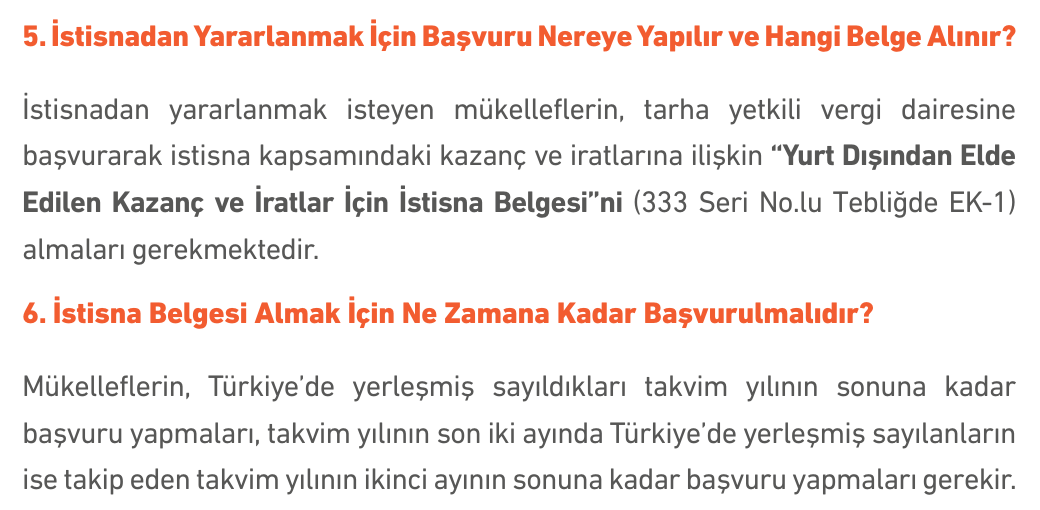
Step 4. Apply to the competent tax office
The full name of the exemption certificate:
Yurt Dışından Elde Edilen Kazanç ve İratlar İçin İstisna Belgesi — exemption certificate for foreign earnings and revenues.
The procedure refers to the form in annex EK-1. The tax office checks residence, the history of the previous three years and whether the application was made on time. Once the conditions are confirmed, it issues the document. Communiqué No. 333, Articles 3–4.
Check with your tax office in advance how to submit the application, which supporting documents to include and whether translations are needed. Don’t treat a list from an agency’s article as an official, exhaustive list.
Step 5. Keep the evidence and keep separate records
Keep the registered application, the exemption certificate, contracts and documents on the sources of payments. Keep separate records of exempt foreign income and of income that does not fall under the relief.
Under the law, qualifying exempt income does not require an annual income tax return and is not included in one when other income is declared. This does not mean that a person no longer needs any documents or tax returns at all.
Application deadline: where you can lose the relief
| When you become resident under the applicable rules | Latest period for submitting the application |
|---|---|
| January to October 2026 | By the end of 2026 |
| November to December 2026 | By the end of February 2027 |
| January to October of any other year | By the end of the same calendar year |
| November to December of any other year | By the end of February of the following year |
These are deadlines for submitting the application, not a promised timeframe for issuing the certificate. Check separately whether the last day is procedurally moved if it falls on a weekend or public holiday. The basis is Communiqué No. 333, Article 3(4).
The official document includes an example of a late application: a person becomes resident in 2028 but only applies in 2030. They are not issued the certificate, even though the other conditions were met.
For those who moved in early 2026, the practical takeaway is simple: don’t put off the application until the next tax return season.
Three real-life situations: who should look at Turkey
These are hypothetical scenarios, not stories of real applicants and not individual tax opinions.
An investor with dividends and a flat abroad. The clearest candidate for looking into the regime: foreign dividends and rent are exactly what the official examples show. It still needs checking, above all the previous three years, taxes in the source countries and obtaining the exemption certificate.
A freelancer who will work from Turkey. The interest in the news is understandable, but the main question is not the certificate: it is how active earnings are classified. Calculating savings before a written analysis is premature.
The owner of a foreign business who will manage it from Turkey. Separate personal dividends from the company’s taxes. An exemption for an individual does not automatically exempt the business. Ask a separate question about the consequences of managing the company from a new country: these risks cannot be covered by one personal certificate.
Zero in Turkey does not mean zero worldwide
The relief operates within the Turkish tax system. It does not cancel taxes that another country may levy on rent from property located there, on dividends or on other income.
A further separate question is ending your residence in your previous country. Changing your address and moving are not always enough: family, housing, work and the provisions of a double taxation treaty may all matter.
So don’t calculate “old tax minus zero”, but the total tax burden across all the countries involved. The general framework of the Turkish rules and the role of treaties are explained by PwC.
Comparing this regime with Cyprus, Uruguay or the UAE on the “0%” figure alone is not enough either. A meaningful comparison needs the same type of income, way of working, company status and cost of legal residence. The same advertising headline does not mean the same result for you.
What is already known and what cannot be promised yet
The law and the application procedure exist. This is no longer at the stage of rumours or a draft bill. In September 2026 the tax administration published a separate GİB guide.
But as of 13 September 2026, this is a very young regime. In this article I do not confirm that the certificate is actually issued within any particular number of days, and I do not present the tax authority’s illustrative examples as completed cases. Assessing practice requires information about a specific tax office and confirmed applications.
Twenty years in the law is not a guarantee that the law will not change. That is the exemption period provided for today. A promise that “the conditions will definitely stay the same for the next twenty years” would go further than can reasonably be claimed.
The certificate does not protect you from incorrect underlying information. If it turns out that the conditions were not met, the consequences may include cancellation of the document, additional tax, a penalty and interest. This is provided for in Article 5 of Communiqué No. 333.
The tax regime and banking are separate questions. An exemption certificate does not guarantee that you can open an account or pass a bank’s checks. But stories of “unjustified account blocks” without verifiable details should not be turned into established fact either. A practical approach: find out the requirements of the bank you have chosen and prepare documents on the source of funds.
What to gather before talking to an adviser
This is a working list for preparation, not an official list of mandatory attachments:
- a timeline of where you lived and worked over the three previous calendar years;
- information on previous income and tax liabilities in Turkey;
- documents on your residence in your previous country and a plan for changing it;
- a list of your sources of income with amounts and countries;
- contracts with your employer and clients;
- documents on foreign dividends, rent and other payments;
- a description of where the work is physically performed and where the business is managed;
- a plan for legal residence in Turkey;
- a calculation of total costs: taxes, accounting, advice, insurance and living costs.
The outcome of the consultation should not be “everything applies to you”, but a written answer for each source of income, the residence date and a plan for submitting the application.
Frequently asked questions
Do I need to buy property or get citizenship?
Article 20/D does not set buying property, an investment threshold or obtaining Turkish citizenship as conditions for this relief. But a legal basis for residence is a separate task. Don’t buy property you don’t need just because someone linked two different programmes.
Does the relief extend to my company?
No, Article 20/D itself is intended for individuals. The document states directly that corporate taxpayers cannot use it. Personal payments to the owner and the business’s taxes are analysed separately. Communiqué No. 333, Article 3(10).
I became resident in spring 2026. Is it too late?
Not necessarily. The regime covers qualifying new residents from 1 January 2026, and the general application deadline is the end of the year in which residence begins. First check the conditions and the exact date, then apply on time.
If the money goes to a foreign account, is the income definitely foreign?
No. Where the money is credited does not replace an analysis of the source of income. And the other way round: a transfer to a Turkish bank does not automatically turn foreign rent into Turkish rent. Look at the income itself and at your status, not just at the route the payment takes.
Can I get the certificate now and sort out my income later?
That is the wrong order. Confirmation of your right to the regime does not mean that every payment you receive is automatically exempt. It is better to classify your income before you build a moving budget around a zero rate.
My conclusion
Turkey really has made a strong move. For the right person with foreign income, a twenty-year exemption can be a serious argument in favour of moving.
But the useful version of the news does not read: “All remote workers now pay no tax for twenty years.”
It reads: “New residents now have a long-term exemption regime for qualifying foreign income. You need to check the source of income and the history of the previous three years, and obtain the exemption certificate on time.”
Less sensation, but far more use for a decision that costs money and changes your life.
Pre-move checklist: eight boxes to tick
- The three previous calendar years have been checked, not just the last 36 months.
- The date your tax residence begins has been established.
- Each source of income has been classified separately for the purposes of Article 20/D.
- Remote work has not been declared “foreign” simply because of a foreign client.
- The owner’s taxes and the company’s taxes have been calculated separately.
- Remaining obligations in the previous country and in the countries where the income arises have been checked.
- The application procedure, documents and deadline for the İstisna Belgesi have been confirmed.
- The moving budget covers not only tax, but also living costs, professional support and risks.
This material helps you prepare questions and check promises, but it does not replace an individual tax opinion. Rules and practice may change; before applying, check the current version of the documents.
Sources and where to check for yourself
- Communiqué No. 333 of 4 July 2026: full text in LEXPERA. Contains the text of Article 20/D, the conditions, the deadlines and examples of how it applies.
- Law No. 7582: original text in LEXPERA. The provision on foreign income is Article 4; the application dates are in Article 14.
- The GİB guide, September 2026, publication No. 616. Official explanations and tables; the illustrations are taken from it.
- Vialto Partners: obtaining the exemption certificate and the consequences of missing the deadline. Analysis dated 14 July 2026.
- PwC: taxation of different types of income for individuals. Page checked by the authors on 9 September 2026; the general rules should be read together with the special exemptions.
- KPMG: Law No. 7582 and the application dates.
- Article 7 of the Income Tax Law: reproduction of the text in Mevzuat Bankası. It is important to take into account the scope of the article rather than taking a single line out of context.