By the Expat Gate editorial team · Accurate as of 3 November 2026. Limits come from the official websites of deposit insurance agencies and central banks; euro amounts are approximate, at the ECB rate of 2 November 2026.
Short answer. If a bank fails, the state only pays back deposits up to a limit: €100,000 per person per bank in the European Union, €50,000 in Serbia, $250,000 in the United States. In Thailand, Vietnam, Australia and New Zealand the cover does not apply to foreign-currency deposits, and the UAE has no state deposit insurance at all. Even insured money is frozen for a while: payouts start days or weeks after the bank closes.
Deposit insurance limits in 20 countries popular with people who relocate
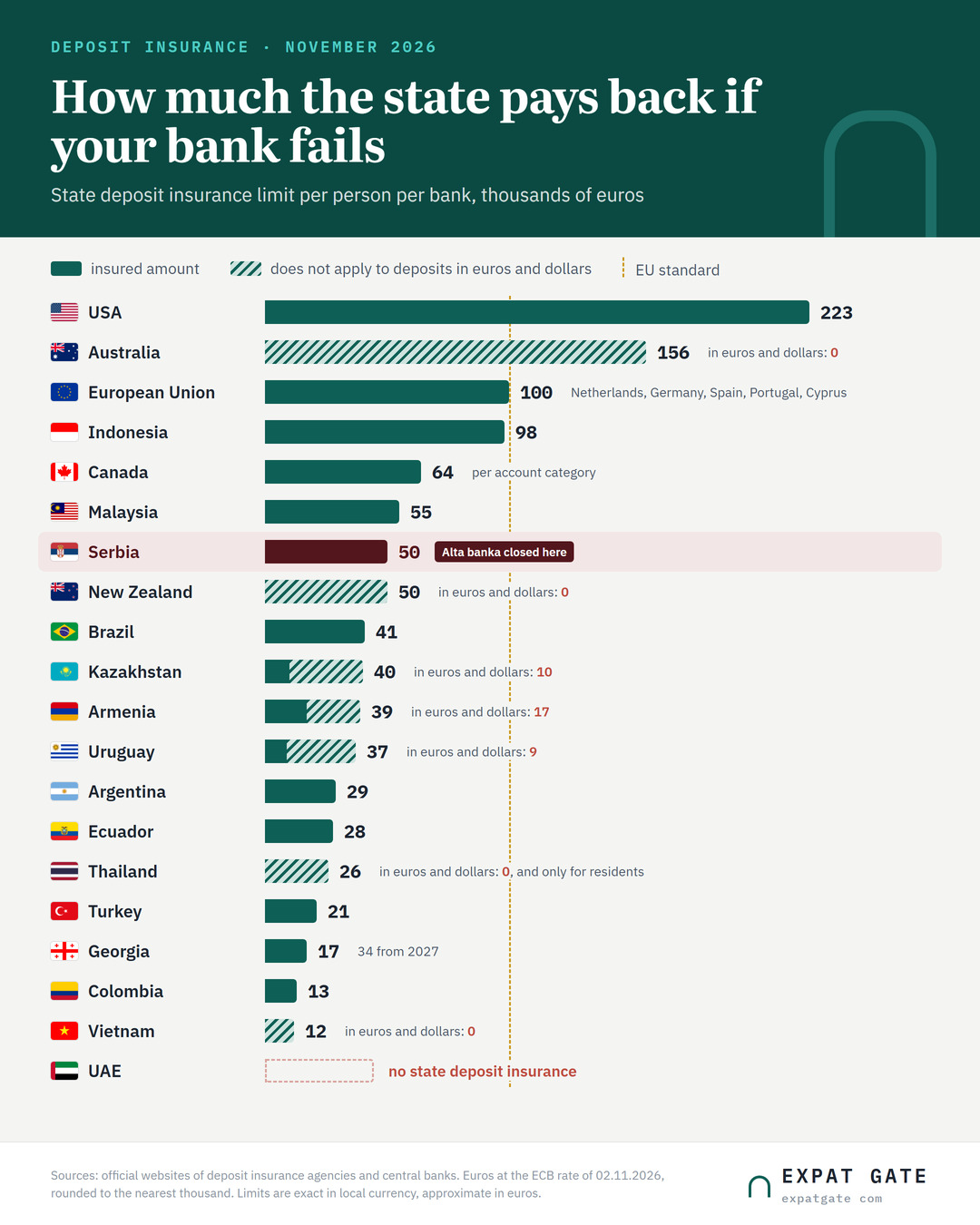
The table gives the limit in local currency, as the law sets it, and roughly in euros. The last column answers the question that matters most to an expat: are the euros or dollars you keep in the account insured? On a phone, scroll the table sideways.
| Country | Limit in local currency | ≈ euros | Deposits in euros and dollars |
|---|---|---|---|
| European Union, including the Netherlands, Germany, Spain, Portugal, Cyprus | €100,000 | 100,000 | Insured, in any currency |
| Serbia | €50,000 (in dinars at the exchange rate) | 50,000 | Insured, all accounts at one bank under one limit; foreign-currency deposits are paid out in euros |
| United States | $250,000 per ownership category | 223,000 | Insured |
| Australia | A$250,000 | 156,000 | Not insured, Australian-dollar accounts only |
| Indonesia | Rp 2 billion | 98,000 | Insured, if the interest rate does not exceed the rate set by the LPS agency |
| Canada | C$100,000 per account category | 64,000 | Insured |
| Malaysia | RM250,000 | 55,000 | Insured, but combined with ringgit deposits under one limit |
| New Zealand | NZ$100,000, since 1 July 2025 | 50,000 | Not insured |
| Brazil | R$250,000, no more than R$1 million over four years | 41,000 | No data |
| Kazakhstan | 20 million tenge for tenge savings deposits, 10 million for other tenge deposits | 40,000 | Only up to 5 million tenge, about €10,000 |
| Armenia | 16 million drams | 39,000 | Only up to 7 million drams, about €17,000; paid out in drams |
| Uruguay | 250,000 indexed units for peso deposits | 37,000 | Only up to $10,000, about €9,000 |
| Argentina | 50 million pesos, since 1 April 2026 | 29,000 | Insured; deposits paying above the central bank benchmark rate are not covered |
| Ecuador | $32,000 at banks | 28,000 | The dollar is the national currency |
| Thailand | 1 million baht | 26,000 | Not insured; baht accounts are insured only for people who live in Thailand |
| Turkey | 1.2 million lira for 2026, reviewed every January | 21,000 | Insured, paid out in lira |
| Georgia | 50,000 lari, 100,000 lari from 1 January 2027 | 17,000 | Insured, paid out in lari |
| Colombia | 50 million pesos | 13,000 | No data |
| Vietnam | 350 million dong, since 13 July 2026 | 12,000 | Not insured, only individuals' dong deposits |
| UAE | No state deposit insurance: the law allows one to be set up, but we found no scheme in operation | - | Not insured |
What the table shows. The size of the limit matters less than it seems. Someone who brought the euros from selling a flat to Thailand or Vietnam and keeps them in euros is not insured for a single euro, even though both countries have a limit. In Kazakhstan, Armenia and Uruguay, foreign-currency deposits are insured for two to four times less than local-currency ones.
The table covers the EU countries where expats live most often, the Asian and South American countries popular with people who relocate, the countries many people moved to from Russia after 2022, and the US, Canada, Australia and New Zealand. Exchange rates move, so the "≈ euros" column shows the order of magnitude, not an exact figure.
What happened in Serbia, and why it matters beyond Serbia
On 31 October 2026 the National Bank of Serbia revoked the licence of Alta banka: the bank's financial position had deteriorated sharply and depositors' interests were at risk. The bank is going into bankruptcy, managed by the Deposit Insurance Agency. On 2 November the bank's owner, Davor Macura, was detained: prosecutors suspect that 45 billion dinars, about €383 million, were taken out of the bank. This is a suspicion, not a charge.
People who moved from Russia were hit hardest. After 2022 Alta was one of the few Serbian banks that would quickly open an account for them, and an account is needed for a residence permit. According to Radio Free Europe, about 6,500 firms set up by Russians have an account at Alta. Money from flats sold in Russia went there, and so did salaries. In the first days after the closure, cards, the app and branches all stopped working.
The agency says it will pay out the insured €50,000 no later than seven working days after a court opens bankruptcy proceedings. Anything above that can only be claimed as a creditor of the failed bank, and how much the bank has left is not yet known.
Foreseeing this is almost impossible, especially when you leave in a hurry and open an account wherever they will take you. Banks fail in rich countries too. But the insurance limit, the currency rules and the payout rules can be checked in advance, and they decide how much money comes back.
What deposit insurance covers and what it does not
- The limit is per person per bank. Two accounts at the same bank are added together and insured as one. The same money spread across two or three different banks is insured at each of them up to the limit. In the Netherlands, banks operating under one licence count as one bank, even if they trade under different names (DNB rule).
- Currency of the deposit. In the EU, Serbia, the US, Canada, Malaysia, Turkey and Georgia foreign-currency deposits are insured, though the payout is sometimes made in local currency at the exchange rate. In Thailand, Vietnam, Australia and New Zealand they are not. In Kazakhstan, Armenia and Uruguay the limit for foreign currency is lower.
- Who is insured. As a rule, individuals. In Serbia sole traders and small and medium-sized firms are also covered. In Turkey company deposits have been covered since 2022. In Vietnam only individuals' deposits are covered.
- Interest rate. In Indonesia and Argentina a deposit paying above the official benchmark is not insured. A high rate at a small bank can cost you your cover.
- Branch of a foreign bank. If you keep money in the Netherlands at a branch of a bank from another EU country, its deposits are insured by that country's scheme, not the Dutch one. Australian cover applies only to banks incorporated in Australia.
- A temporarily large balance. In Germany, Spain and Cyprus money from a home sale and after some other life events is temporarily insured above €100,000: in Germany up to €500,000 for six months, in Cyprus up to €300,000 extra for a year, in Spain for three months.
How long a payout takes
The clock starts not when the bank closes but at an official decision by a court, the regulator or the agency. These are the deadlines stated on the agencies' own websites:
- European Union: 7 working days. In the Netherlands and Portugal this deadline has applied since 1 January 2024.
- Serbia: no later than 7 working days after the court's bankruptcy ruling.
- Australia: the aim is to pay most depositors within 7 calendar days.
- Georgia: 20 calendar days after liquidation begins.
- Uruguay: 30 calendar days after liquidation.
- Vietnam: 45 days.
- Turkey: 3 months, which can be extended.
All this time the money is out of reach. That is why a second card at another bank, ideally in another country, is not an emergency measure: it lets you keep paying for housing and food while the payout is processed.
What to check before you move
- Find the website of the deposit insurance agency in your destination country. It is usually called a Deposit Insurance Agency or Deposit Guarantee Scheme; links for 20 countries are in the table above.
- Check the limit per person per bank and the date it applies from. Limits change: Vietnam raised its limit in July 2026, Argentina in April, and Georgia will raise its limit in January 2027.
- Check whether deposits in the currency you plan to hold are insured. If not, decide in advance whether to keep your savings in local currency or in another country.
- Make sure your bank is a member of the scheme, and find out whether it is a branch of a foreign bank.
- If your savings exceed the limit, spread them across several banks with different licences.
- Keep a second card at another bank with at least a month of living costs on it.
Questions
Are deposits of foreigners and non-residents insured?
In most countries, yes: the cover is tied to the deposit, not the passport. The agencies of the US, Malaysia, Georgia, Kazakhstan and Turkey say so directly, and in the Netherlands all account holders are covered except government bodies and financial firms. The exception in the table is Thailand: baht deposits are insured only for foreigners who live in the country.
What happens to money above the limit?
You can claim it as a creditor in the bankruptcy. How much you get back, and when, depends on what the bank has left; in Serbia some proceedings for banks closed in 2011 are still not finished.
Can I keep my money at home and pay by card abroad?
You can, if your bank at home is sound and its card works in your new country. For many people who moved from Russia this route is closed by sanctions, which is why the bank they put their savings in after the move matters so much.
Where is Serbia in the Expat Gate migration policy ranking?
Serbia: 20th out of 97. The ranking measures how a state treats people who move there: how its agencies work, pressure on newcomers, how secure a residence status is. It does not measure how sound the banks are, so a high place does not protect your account.
Sources
- National Bank of Serbia, decision to revoke Alta banka's licence, 31.10.2026
- Serbian Deposit Insurance Agency, notice on payouts to Alta banka depositors, 31.10.2026, and questions and answers on deposit insurance
- Radio Free Europe, "Ostala sam bez ušteđevine" - Alta's Russian clients, the owner's detention, the number of firms
- European Commission, deposit guarantee schemes in the EU
- Country agencies - see the links in the table. Payout deadlines and special rules: EdB (Germany), FGD (Spain), FGD (Portugal), Central Bank of Cyprus, APRA (Australia)
- Exchange rates: ECB as of 02.11.2026; for currencies the ECB does not publish, the Luxembourg customs monthly rate for October 2026
Checked by the Expat Gate editorial team on 03.11.2026. This is not financial advice.