From January 2028 Europe gets more expensive in exactly the places where a newcomer already spends a noticeable share of their money: petrol in the tank and heat in the home. On 23 November 2026 eight climate ministers sent a letter to Brussels asking that this date be moved no further. The letter never uses the words "relocation", "rent" or "heating bill", but it is worth reading if you are sitting with a spreadsheet of European countries, deciding where to take your family.
The decision has been made, it has already been put off once, and eight countries have just declared that they will not allow it to be put off again.
23 November: eight countries shut the door on a delay
The Jetten cabinet in the Netherlands has demanded that the EU climate commissioner, Wopke Hoekstra, hold the line: the levy must start working in 2028, with no new delays and no softening. The Netherlands is not alone in this. The letter to Hoekstra was signed by the climate ministers of eight countries: Denmark, Finland, Germany, Luxembourg, the Netherlands, Portugal, Spain and Sweden. The Dutch signature came from climate minister Stientje van Veldhoven of the D66 party.
Their argument in the letter is put like this: "it is obvious that we must reduce our dependence on imported fossil fuel in order to escape the influence of geopolitical tension and price shocks." And further on, these are "factors that harm companies and households, put our energy security at risk and leave us vulnerable to political pressure."
In short: these eight countries no longer want the price of petrol at home to depend on somebody else's war. The method they have chosen is to make fossil fuel more expensive inside Europe so that people come off it faster, and off imports along with it. The levy itself is charged on petrol, diesel, heating oil and gas, wherever they come from.
Eight signatures are more than a gesture. According to a European diplomatic source cited by Euronews, these countries form a blocking minority in the Council of the EU. Which means the levy cannot be scrapped without them. The letter is addressed to the commissioner, but it was written for the ten countries that are asking for the scheme to be rewritten before it starts.
De Telegraaf, where we took the text of the letter from, calls this levy the "Timmermans-taks", a tax with a politician's surname attached, and describes the way it works as a "green straitjacket": anyone who does not switch to something new pays more year after year at the pump, for the gas hob and for the gas boiler. There are 723 comments under the article: in the Netherlands people are arguing about this levy already, even though they will only start paying it in a little over a year.
What this levy is, and why you will be the one paying
Its official name is the EU Emissions Trading System for buildings and road transport, ETS2 in EU documents, and in everyday speech people simply call it the EU carbon tax. Formally it is not a tax, and you will see in a moment why that distinction matters. It is built in a way that makes it easy not to recognise yourself in it.
The driver does not pay. Nor does the tenant. The fuel supplier pays: whoever brings in the petrol, diesel, heating oil and gas. He buys the right to emit and books the cost as an expense. And a supplier's expenses end up in the price on the pump and in the tariff on your heating bill. Formally, this is not a tax on people. In practice it is a price that people will see last and with no explanation, simply as "it has gone up again".
The honest version is scarier than the slogan: there will be no "climate levy" line on your bill. There will just be a different number.
The levy has been postponed once already: it was due to start in 2027 and will now start in 2028. And it has no hard price cap. There is a mark of 45 euros per tonne of emissions, in 2020 prices adjusted for inflation: if the price climbs above it, extra allowances are released onto the market from a reserve. That is a brake, not a ceiling, and it is the main thing missing from any calculation of "how much will this cost".
Part of the money collected is supposed to come back to people through the Social Climate Fund: 65 billion euros according to an earlier estimate, at least 86.7 billion euros for 2026-2032 according to a more recent one. But it will not land in your personal account. The money goes through national "social climate plans": insulation, replacing heating systems, transport, sometimes temporary allowances. Each country decides for itself who gets into the programme.
And here is the detail that anyone relocating should put right at the start of their sums: the cushion will be thinner where the country is richer. Fund money goes mainly to Eastern Europe, while the Netherlands gets roughly the least per person out of it and is preparing its own support measures for vulnerable groups out of its own budget.
What it comes to in money: between 10 and 70 euros a month
There are few official figures, and we quote only those. The Dutch state agency Planbureau voor de Leefomgeving (PBL) worked out in a report this year what things will look like by 2030.
A small flat and 6,000 km a year, which means a car used at weekends: plus 10-20 euros a month, or 120-240 euros over a year. An old, large detached house and 20,000 km a year, which means a job in another town: up to 30 euros a month, and up to 70 in the worst case, or up to 840 euros over a year. On top of that, companies will pass their own costs into the price of everything else: up to 10 euros a month in the first year the levy applies. And PBL adds a separate warning: after 2030 prices may rise considerably further.
This is a forecast, it was made for the Netherlands, and it is about 2030. For your country and your home, nobody has figures like these.
But look at what separates the 10 euros from the 70 euros. Not the country, not politics, not slogans. Two things: how the home is heated, and how much the person drives. An old, large house on gas plus a car every day is the most expensive combination PBL calculated.
PBL warns outright of the risk of "energy and transport poverty" for vulnerable households that cannot afford an expensive heat pump or an electric car. That is the whole logic: the person who pays the most will be the one with no money to pay less. De Telegraaf writes about heavy blows to small businesses, above all those that live on fuel and on the hob: cafe and restaurant owners, bakers, owner-driver lorry drivers. If you are planning to start your own business, budget for this line in advance: we have written about lines like this in our guide on what to check before starting a business abroad.
Germany: there it is already on the receipt
The most useful thing here is that this story does not have to be imagined. Germany already has a national emissions levy of its own, and you can see what it costs per litre. The price corridor for 2026 is 55-65 euros per tonne, and allowances are going at the top of it, at 65, because demand outstrips supply. At 65 euros per tonne the levy adds 15.6 cents a litre to petrol, 17.4 cents to diesel and 17.4 cents to heating oil as well. This is not a forecast for 2030 but the arithmetic of a levy already working in Germany: 17.4 cents a litre of diesel is about 9 euros on every full 50-litre tank.
And here is what is worth noticing. On 15 October 2026 the Bundestag kept the 55-65 euro corridor for 2027 as well, even though under the old rules the price would have come out at around 80 euros per tonne (that is the FÖS institute's estimate). And a little over a month later, on 23 November, Germany signed the letter saying the Europe-wide levy must not be softened. For its own voters the increase was held back; for the common rule it was not. From 2028 Germany moves over to the Europe-wide levy anyway, and that one has no ceiling at all.
Two camps: where the blow will be cushioned, and where it will not
But the most important thing in this story is not the levy itself. It is that Europe has split into two camps over it. That split says more about these governments than their election manifestos do.
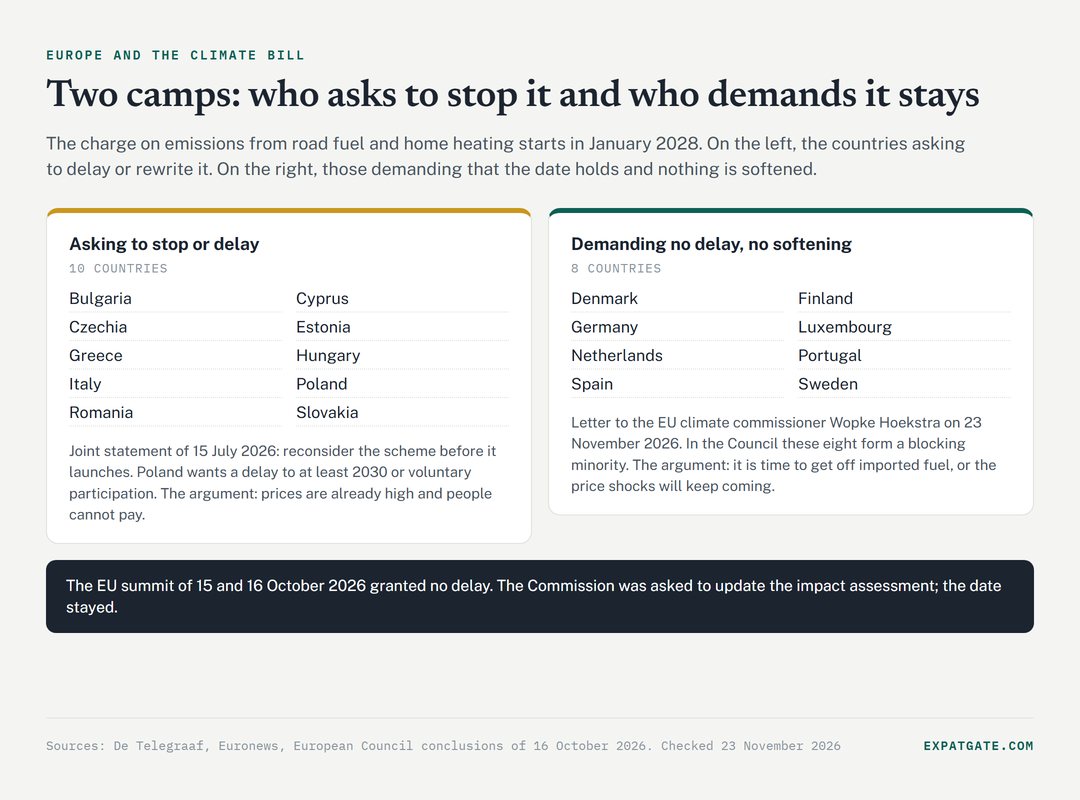
The eight countries behind the letter to Hoekstra believe the rules cannot be changed: investors need predictability, Europe has to move off imported fuel, and you cannot rewrite one part of the deal without wrecking all of it. This is the position of those who think changing the rules halfway costs more than seeing them through.
The second camp is looking at next winter. On 15 July 2026 ten countries signed a joint statement asking for the scheme to be reviewed before launch: the loudest of them were Italy, Poland, Czechia and Hungary, with the full line-up in the chart above. Their argument is simple: people's purchasing power is already stretched to the limit, and prices are high as it is.
Poland goes furthest of all: delay it until at least 2030, or make taking part voluntary. Climate minister Paulina Hennig-Kloska said it without any diplomacy: "we do not need higher fuel prices; countries like Poland do not cut taxes only to bring them back in by the side door." And unlike the Netherlands, Poland has already cut taxes to bring down prices that had been driven up by the Middle East. The Polish press quotes calculations under which heating with gas will cost an average family 6,638 zloty more over four years, roughly 140 zloty a month, and up to 12,100 zloty in homes that use a lot of energy. We have not checked the methodology behind those calculations.
At the EU summit on 15-16 October 2026, six countries demanded a delay until 2030: Poland, Czechia, Slovakia, Hungary, Italy and Greece. The delay was refused. According to the European Council conclusions, the Commission was asked to do only one thing: recalculate what the levy will cost people, and improve the safety valves that trigger if the price rises too fast (the Council adopted the amendment on the allowance reserve on 9 October 2026). In other words, arguing about the design was allowed, arguing about the date was not. Italy was promised a review of the impact assessment; a postponement it did not get.
Here is what this split means in practice. In a country from the first camp, the blow will be cushioned reluctantly: its government has only just put its name to the view that nothing should be softened. In a country from the second camp, the government has already shown that its answer to expensive fuel is to cut taxes and top up incomes. This is not about who is right. It is about temperature: how things are usually done here when life starts getting expensive for people.
And right behind that comes the other half of the truth, without which the picture lies. Social Climate Fund money goes mainly east, which is to say precisely where the governments are against the levy. That leaves an awkward fork: in Spain or Portugal the government is for the levy, but there is little fund money per person; in Poland or Hungary the government is against it, and the fund goes there. None of this makes a country "good" or "bad". It tells you who you will be dealing with when prices go up.
Why fuel and heating in Europe are already getting more expensive
There is a backdrop to the whole story that has turned the argument nasty. The Strait of Hormuz has been effectively closed since February 2026.
The head of the European Commission, Ursula von der Leyen, says that since the strait was effectively closed, Europe has paid roughly 127 billion euros more for imported oil and gas. Gas on the TTF exchange climbed to a four-year high of around 86 euros per MWh. In March, petrol in Germany went from about 1.82 to 2.16 euros a litre in two weeks: plus 34 cents, almost 19%.
And in Spain fuel rose by more than a third, by 34%, and that was with no levy at all. The EU expects prices to stay above pre-war levels until at least the end of 2027.
Both sides use the same shock as their main argument, and each is right in its own way. The eight ministers say: this is exactly why we have to come off imported fuel, otherwise it will happen every time somebody closes another strait somewhere. Their opponents say: people are already not coping, you cannot pile more on them now. The argument is not about whether life is expensive, but about who pays for the way out.
For anyone choosing a country there is a third conclusion here, one that neither camp says out loud: there is no cheap option. Imported fuel is expensive already today, and 127 billion euros is a bill Europe paid with no levy at all. You are not choosing between "expensive" and "not expensive", but between different ways of becoming more expensive.
What this means if you are choosing a country right now
If we were comparing two or three countries, we would do three things.
First, we would stop doing our sums at today's prices. January 2028 is close. A flat you rent or buy in 2027 will be heated under the 2028 rules and the ones after that. The decision has been taken, eight countries are defending it, and October's attempt at a delay failed.
Second, we would look not at the country but at the house and the commute. Before arguing about tax regimes, ask the landlord or the seller: how is this place heated, what does the January bill come to, how much does it cost to replace the boiler. If the house is old and on gas and work is forty kilometres away, the country barely matters: you are in the most expensive category there is.
Third, we would ask what the country does for people like you. Every social climate plan has people who get help and people who do not. Nobody has yet published who exactly each country will write into its plan. But a newcomer who rents is in an inherently shaky position: they do not own the place and cannot insulate somebody else's house, and the subsidy is given for what you buy. This is worth asking about before you move, not during your first winter.
A heat pump and an electric car are not a moral choice here but arithmetic: whoever cannot buy them pays the most. With only a modest buffer of money, it makes more sense to pick a home that does not need an expensive overhaul than to hope you can pay for one later.
It is worth finding out about January 2028 before you sign a lease on an old house with a gas boiler.
Comparing countries by how much they take from a newcomer is easier with our own material: there is our ranking of 97 countries and a list of low tax countries for expats. But keep in mind that from January 2028 any calculation of the cost of living in Europe gains a line that is not in those tables: the price of heat and petrol.
Frequently asked questions
Has the levy already been introduced?
No, it comes into force in January 2028. It has been postponed once already, from 2027 to 2028; ten countries are asking for it to be reviewed before launch, and six of them demanded a delay until 2030. But in October 2026 the delay was refused, and in November eight countries demanded in writing that there be no further retreat. In Germany the national levy is working already, and that is where you can see the price in cents per litre.
Is this a new EU tax on people?
Formally, no: it is fuel suppliers who buy the right to emit. Their costs end up in the price of petrol, diesel, heating oil and gas, and from there in your receipt at the pump and your heating bill. There will be no "levy" line on the bill.
Will heating and petrol prices go up, and by how much for me?
Nobody knows, and anyone who names an exact figure has made it up. There is one official calculation, by the PBL agency, and it is about the Netherlands and about 2030: from 10-20 euros a month for a small flat and 6,000 km a year, up to 30 and even 70 euros a month for an old, large detached house and 20,000 km a year. And separately, already in the first year, up to 10 euros a month because companies pass their costs into prices. After 2030, PBL warns, prices may rise considerably further.
Is there a limit above which the price cannot go?
There is no hard ceiling. There is a mark of 45 euros per tonne in 2020 prices adjusted for inflation: if the price climbs above it, extra allowances are released onto the market from a reserve. That is a brake, not a ceiling. For comparison: in Germany, where the national levy is already working, allowances are going at 65 euros per tonne because demand outstrips supply.
Will we be compensated for any of it?
Partly, and not everyone, through the national plans of the Social Climate Fund: insulation, replacing heating systems, transport, sometimes temporary allowances. The bulk of the fund goes to Eastern European countries, while the Netherlands gets roughly the least per person and is preparing support measures for vulnerable groups of its own.
Could it still be scrapped?
Scrapping it altogether is not possible now: the eight countries behind the letter form a blocking minority in the Council of the EU. What is genuinely on the table is the design and the safety valves: the Commission has been asked to update the impact assessment, and work on the market stability reserve is to be speeded up. We would not plan a relocation on the assumption that the levy will never happen.
How we checked this, and what these figures do not tell you
The letter from the eight ministers, the quotes from it, the names "Timmermans-taks" and "green straitjacket" and the figure of 723 comments come from a De Telegraaf article of 23 November 2026 by its Brussels correspondent Alexander Bakker. The blocking minority in the Council of the EU was reported by Euronews the same day, citing a European diplomatic source.
The outcome of the 15-16 October summit is taken from the European Council conclusions of 16 October 2026. The 2030 calculations were made by the Dutch state agency PBL. The German cents per litre and the 55-65 euro corridor per tonne relate to Germany's national levy: the Bundestag passed the amendment on 15 October 2026, and the estimate of "around 80 euros under the old rules" comes from the FÖS institute.
Now, honestly, about the gaps, because there are more of them than we would like.
The only detailed official calculation of household costs was made for the Netherlands and for 2030. For the other countries our sources contain no such calculations, so 10-20 or 70 euros a month cannot be carried over to Spain, Czechia or Portugal: the housing is different, the heating is different, the distances are different. The Polish figures (6,638 and 12,100 zloty over four years) come from the Polish press, and we have not checked the methodology.
The German add-ons we know for petrol, diesel and heating oil. There was no comparable figure for gas in our source, and we did not invent one, even though gas is the main question for most of our readers.
We do not know what a tonne of emissions will cost in 2028 or later: there is no ceiling. And we do not know how Social Climate Fund money will be shared out inside each country, or whether recent arrivals and people who rent will make it into its programme. That is the most important thing for our reader and the most opaque part of the whole story.
And one last thing. We are not claiming that Europe is becoming impossible to live in, and we are not saying which camp is right. Costs are rising with no levy at all, and the 127 billion euros overpaid for imported fuel is an argument for exactly those who are defending the levy.