The Expat Gate editorial team · Checked 8 November 2026. Every number here is taken from the statistics of police forces, prosecution services and the relevant agencies, from the annual reports of Jewish organisations and from the surveys of the EU Agency for Fundamental Rights. For every number we say who counted what.
One autumn in one country
The lecture cancelled an hour before it was due to start
On 3 November 2026 Maastricht University cancelled a lecture less than an hour before it was due to begin. All that day the university and the city searched for somewhere to move it. Every new address leaked online before anyone could get to it.
The speaker was to be an Israeli academic, Dr Eliyahu Sapir, and the title was "Three years after 7 October". Pro-Palestinian groups announced they would disrupt the meeting and circulated information about the lecturer himself online. The decision to cancel was taken after a consultation with the mayor, the prosecution service and the police: the risks, in the university's wording, were stacking on top of each other. Academic freedom, the university admitted, had been curtailed, and it called the episode a defeat.
The invitation had come from the Jewish student association IJAR and the organisation StandWithUs. In their words the university is yielding to intimidation, and what is happening they call a systematic suppression of Jewish student life on campus. A Jewish student event in Maastricht, they say, has now failed three times in a row. The students refused to hold the lecture online.
Two days later it was discussed in parliament. Minister Rianne Letschert, before politics the rector of that same university, said word for word: "Elke keer lekten die locaties uit" (every time those locations leaked). And she added that this is absolutely unacceptable.
In the same debate she said the thing that matters: universities' own security cannot cope with this. And she asked the question the state has no answer to yet. How do you make safety something arranged in advance, so that lectures can actually take place?
The same university, the same autumn: the student they reinstated
Hussein Issa, 22, was admitted to Maastricht University in June 2026 under its own programme, in a group of roughly 47 students from Gaza. He is studying computer science.
In September 2026 he posted a short video on Instagram. In the NOS description, which nobody disputed, he gives a thumbs up, in the Dutch of the report "steekt zijn duim op" (he raises his thumb), points at a television screen where Al Jazeera is showing footage of the attack of 7 October 2023, and says something to a person sitting next to him on the sofa.
CIDI, the main Jewish organisation in the Netherlands and the very one that keeps the count of antisemitic incidents, translated what he said as "This is me". The translation was picked up by media and politicians. The university suspended the student, citing the safety of students, staff and of the student himself.
On 20 October NOS issued a correction: the words had been misheard. The student was speaking Arabic, not English, and said "tasheshni" (a word of the Gaza dialect; an Arabic translator explained to L1 that it is closer to "take me out for a walk with you"). The sound on the recording is poor, and what exactly was said is, in NOS's own wording, hard to establish. The prosecution service looked into it and found no grounds to consider him involved in the attacks of 7 October.
The correction concerned the words only. The gesture NOS neither disproved nor withdrew: a man gives a thumbs up while looking at footage of 7 October. CIDI's statement that the video glorifies terrorism NOS also reported and also did not disprove. The prosecution service established one thing only: he did not take part in the attack. It did not say the gesture never happened, and it passed no judgement on his posts.
Issa himself says the suspension left him bewildered: he did nothing, and he is being punished. The word he was accused of saying he calls a catchphrase he used to end his clips with, and it appears in earlier posts.
His account was gone through by De Telegraaf, and NOS relayed that analysis. Around 30 thousand followers, mostly freerunning clips, but among them footage with jihadist gestures. There is a post about the martyrdom of his brother Ahmed in Jabalia. And under a photograph of the dead brother, his own words: I ask Allah that my life end the same way yours did, brother. He himself says three of his brothers have been killed and that it only made him stronger.
The university lifted the suspension, calling the case a misunderstanding. But Issa is physically not allowed into classes, he is studying remotely and is challenging the decision through a lawyer. How is he supposed to make friends and build a social life in that position, he asks. His housemates blocked him on Instagram and, according to reports, after threats he is in hiding in The Hague. The university calls the measure temporary, says it is partly in his own interest, and says it wants him back in class as soon as possible.
And on 26 October, when the suspension had already been lifted, the university itself filed a police report against him. The trigger was his posts about the associate professor Amanda Kluveld, which left her feeling seriously threatened: according to De Limburger, he placed an image of a wounded child next to her photograph. This is the content of the report, not an established fact.
The mayor of Maastricht, Wim Hillenaar, said on 29 October 2026 that the city executive understands the case has caused alarm and unease, and that the reports and the publicity that followed affected people's sense of safety. He saw no grounds for additional security measures.
The order of events in one university, from September to the beginning of November:
- September: the video, the thumbs up in front of footage of 7 October, CIDI's translation, the suspension;
- 20 October: the NOS correction, the words had been misheard; the prosecution service finds no involvement in the attack of 7 October;
- then the university lifts the suspension and calls the case a misunderstanding, but keeps him off campus;
- 26 October: the university itself files a police report against its own student;
- 3 November: the same university cancels a lecture by Jewish students, because not one venue can be kept secret.
Dam Square, 7 October: "shocking and distasteful"
The third story of the same autumn is no longer about a university but about what the state is allowed to do with words.
On the third anniversary of the attack on Israel around 150 people gathered on Dam Square in Amsterdam, by the National Monument. They chanted "long live 7 October" and burned an Israeli flag. Masked people held a large green banner reading "we support Hamas", and next to it a second one: "glory to our martyrs, victory to the resistance".
The mayor of Amsterdam, Femke Halsema, said the next day that she had watched with great horror as Hamas was supported in front of the monument, and called it "shockerend en onsmakelijk" (shocking and distasteful). About the content of the banners she could do nothing. Dissolving the demonstration at 20:15 became possible for a different reason: some of the crowd left the agreed route and headed towards a neighbourhood with many Jewish buildings. The police stopped them at Waterlooplein, and some tried to break through the cordon.
The prosecution service explained its non-intervention publicly: "geen sprake van opruiing" (there was no incitement, in the prosecutors' view). And it added that this, of course, does not change the fact that people may experience such wording as offensive. The lawyers asked at the time did not agree among themselves: the question is unsettled inside the profession too.
The mechanics are explained by Jon Schilder, professor of constitutional law. A mayor does not decide what a demonstration is about. Acting in advance is impossible. And the prosecution service, short of capacity, drops a great deal, so prosecution is partly a political choice.
The rule all of this runs on today was written down in plain words by the prosecution service two years earlier, on 14 June 2024, when it dropped a case brought by CIDI: "Verheerlijking van terrorisme roept zonder meer verontwaardiging op, maar is niet strafbaar in Nederland" (glorifying terrorism unquestionably provokes outrage, but in the Netherlands it is not a criminal offence).
A bill meant to change this has been introduced: up to two years in prison for glorifying terrorism and for publicly supporting banned organisations. As of 8 November 2026 it has not been passed, and the minister of justice and security is pressing for it. The prosecution service says plainly that some of these statements will become punishable the moment the bill becomes law. While it sits in parliament, they will not.
What this guide is about
The three stories above took up one autumn and one small country. Not one of them has produced a conviction. And yet the Jewish students' lecture did not happen, the banner supporting Hamas turned out to be lawful, and the mayor of the largest city said "distasteful" and threw up her hands.
The question we are working through is exactly this: how protected a Jew can feel in a particular European country, and what the state does about it. Not "where Jews are liked" and not "who is right in the Middle East", but what happens when something has happened to a person.
Twenty countries, one set of questions: how many cases the state counted and how many the community counted, what happened over three years and how it ended, who pays to guard a Jewish school, what the people at the top say.
The short answer. The countries where Jews feel calmest, by their own account, are not the ones with the fewest incidents. The highest absolute numbers are in the United Kingdom, Germany and France, and that is also where protection is the most expensive and the most effective: Britain spends tens of millions of pounds on guarding the community, Denmark keeps a permanent armed police post outside the Jewish school, France puts soldiers outside synagogues. In Portugal and Hungary the state keeps no count of antisemitic incidents at all, so there is honestly nothing to say about them. The severity of the law and how safe people feel also come apart: in Germany a pro-Hamas slogan gets you a real criminal case, while federal money for guarding communities barely exists; in the Netherlands the same slogan is not punishable, yet military police stand outside Jewish schools.
And one framing. We do not count criticism of the Israeli state as antisemitism. The line was put well by the secretary general of the Central Board of Jewish Communities in Greece, Victor Eliezer: criticism of any Israeli government, however harsh, is not antisemitic behaviour, but blanket labels, calling Israeli citizens murderers, are hate rhetoric already. Where an organisation that keeps a count treats a political statement as an incident, we say so plainly and put the state's figure next to it.
The Netherlands: what it looks like close up
There are around 40 thousand Jews in the Netherlands, 0.3% of the population. The state spends money, says the right things, keeps military police outside schools, almost never takes a case as far as a conviction, and refuses on principle to punish one kind of behaviour. All of it at once, and in a small community every link in the chain is visible.
Three numbers for one and the same year
For 2025 antisemitism in the Netherlands was counted three times and came out as 281, 867 and 139.
- CIDI, the organisation people report to themselves, recorded 281 incidents;
- the police registered 867 reports flagged "antisemitism", and anti-discrimination services another 271;
- the prosecution service opened 46 cases under articles where discrimination is the offence itself, and 93 cases where antisemitism was an aggravating circumstance of an ordinary crime.
Of the 867 police reports, slightly more than 400 were directed against Jews and Jewish institutions. The rest is 240 cases where the word "Jews" was thrown at police officers themselves as an insult during ordinary work, 157 rows between individuals where it is unclear whether Jewishness played any part at all, and more than 70 statements about Israel and Zionism. The police column marked "antisemitism" is half about something else.
The drop in prosecution cases from 80 to 46 looks like an improvement until you add both categories together: 149 cases in 2024 and 139 in 2025. There is no turning point.
CIDI recorded 421 incidents in 2024, a record over roughly forty years of monitoring, and 379 in 2023. The fall in 2025 CIDI itself explains not as an improvement but as reporting fatigue: people stop telling anyone because they see no consequences, and they wear a kippah or a Star of David in public less often, which means they end up in reportable situations less often.
The national coordinator against antisemitism, Eddo Verdoner, says the danger lies elsewhere: we are gradually getting used to unacceptable numbers, and hatred is becoming the new normal. He also explains why numbers read differently in a small community. Jews are 0.3% of the population, so what is large is not only the number of incidents but the chance that you personally will run into one.
From the same speech: when ordering a taxi or food, people give a different name so as not to be recognised.
The night of 8 November 2024
From 00:04 small groups on scooters, fatbikes and in taxis drove around Amsterdam, looking for people who had become separated, beating them and instantly disappearing. Coordination ran through a WhatsApp group and a Snapchat group. Five of the injured ended up in hospital, another 20 to 30 people had light injuries, and 62 people were detained on the first day.
Victims were picked by appearance. That is how it is written in the official report of the Inspectorate of Justice and Security of 16 June 2025: the attacks were on people taken to be Jews, regardless of their actual background.
The authorities' reaction was fast and unambiguous. Prime minister Dick Schoof said there had been a hunt for Jews, that this was undiluted antisemitism and that nothing can serve as a justification for it. King Willem-Alexander: Jews must be able to feel safe in the Netherlands, everywhere and always.
The national coordinator, that same day, 8 November, put into words what Jews themselves read in that footage: hide who you are, do not say where you are from, you are not safe here.
Five days later, opening the debate in parliament, the prime minister said it was distressing to hear how afraid Jewish parents are when their children go outside simply to go to school or to a sports club, and how they increasingly choose, deliberately, to look as little Jewish as possible. That, he said, turns your stomach.
The Marsfit investigation collected tens of thousands of hours of video from more than a hundred cameras. By March 2025 the prosecution service was talking about 122 suspects, 36 of them identified by name. According to court documents, by September 2025 ten people had been convicted, the heaviest sentence six months, and in three known cases the appeal court reduced the punishment. One of the judgments records "Geen discriminatoir aspect" (no discriminatory aspect): the court could not establish a discriminatory motive. Terrorist intent the prosecution service did not substantiate.
A hundred and twenty two suspects and ten sentences, the heaviest of them six months.
Schools, synagogues, monuments
On 13 October 2023 three Jewish schools in Amsterdam closed for a day for fear of violence. On the Monday they opened under guard: Royal Military Police vehicles blocked the street, and gendarmes with automatic weapons stood at the entrances.
On 9 July 2024 the statue of Anne Frank on Merwedeplein, in front of the house where her family lived before going into hiding, was doused in red paint and "Gaza" was written on the plinth. On 4 August, exactly on the 80th anniversary of Anne Frank's arrest, it was doused again and the statue's hands were painted red. There have been no arrests and no convictions in either case.
In June 2025 children's graves were deliberately destroyed at the old Jewish cemetery in Amsterdam-Oost. The cemetery was in use from 1714 to 1914, and 70% of those buried there died before the age of thirteen. Nobody was found.
On the night of 13 March 2026 an explosion went off in Rotterdam and the entrance of a synagogue caught fire. Four people were detained soon afterwards near another synagogue in the city, where, according to the prosecution service, a second attack was prevented; three more were detained later. They are charged with terrorist intent, that is, with the aim of seriously frightening a section of the population. Four admitted taking part but said they had not known in advance that the target was a synagogue. As of 8 November 2026 there is no verdict.
The following night, 14 March, at around 03:45, two people on a scooter placed an explosive device against the wall of the Cheider Jewish school in Amsterdam and rode away. The damage was small and those responsible were not found. Every Jewish school in Amsterdam was given extra security the same day. On 21 May 2026 the same school closed for a whole day because of a threat.
CIDI responded to the blast at the school like this: this place has essentially never been safe and has always needed guarding.
We found no convictions at all for the desecration of Jewish monuments and cemeteries in 2024 to 2026.
What the state is doing meanwhile
Since 2025 the ministry of justice and security has allocated an additional 4.5 million euros a year, structurally, to the fight against antisemitism. A fund for protecting Jewish institutions opened in September 2025: up to 250 thousand euros per applicant. In its first year 45 applications came in for almost twice the sum the budget held; 1.3 million euros were distributed, and for 2026 the fund was raised to 2 million. Amsterdam alone put 25 million euros into protecting Jewish life in the city.
The law moved too. From 1 October 2024 denying and justifying the Holocaust became a separate offence, and the first conviction under it was handed down on 15 January 2025. From 1 July 2025 a discriminatory motive became a statutory ground for increasing a sentence, although as an option for the court rather than automatically, and the motive has to be proved. The national coordinator has been in place since 2021, and the national strategy for 2024 to 2030 contains 57 measures.
The minister of justice and security, David van Weel, said in March 2026, after the two explosions: a synagogue must be a safe home for Jews, and a school a carefree place for children. And he finished by saying that this is not a Jewish problem but a problem of Dutch society.
The argument that runs over the top of all this
PVV leader Geert Wilders said in the debate of 13 November 2024 that he would not accept Jews being chased and hunted in the Dutch capital, and added that it is necessary to name who did it. Rob Jetten, then leader of the D66 group and prime minister since 2026, replied that you do not fight antisemitism with even more filthy racism. A PvdD MP said in 2026 that the PVV uses antisemitism as a stick to beat the Muslim community with; a PVV MP countered that Wilders has fought antisemitism for years and lives under protection himself.
CDA group leader Henri Bontenbal put it this way: it is unacceptable that you can walk through Amsterdam in a hijab but not in a kippah.
And VVD MP Ulysse Ellian, in the debate of 21 April 2026, described exactly what this guide is about: right now the reality at the kitchen table for Jews and Jewish families is the question of whether we stay or leave.
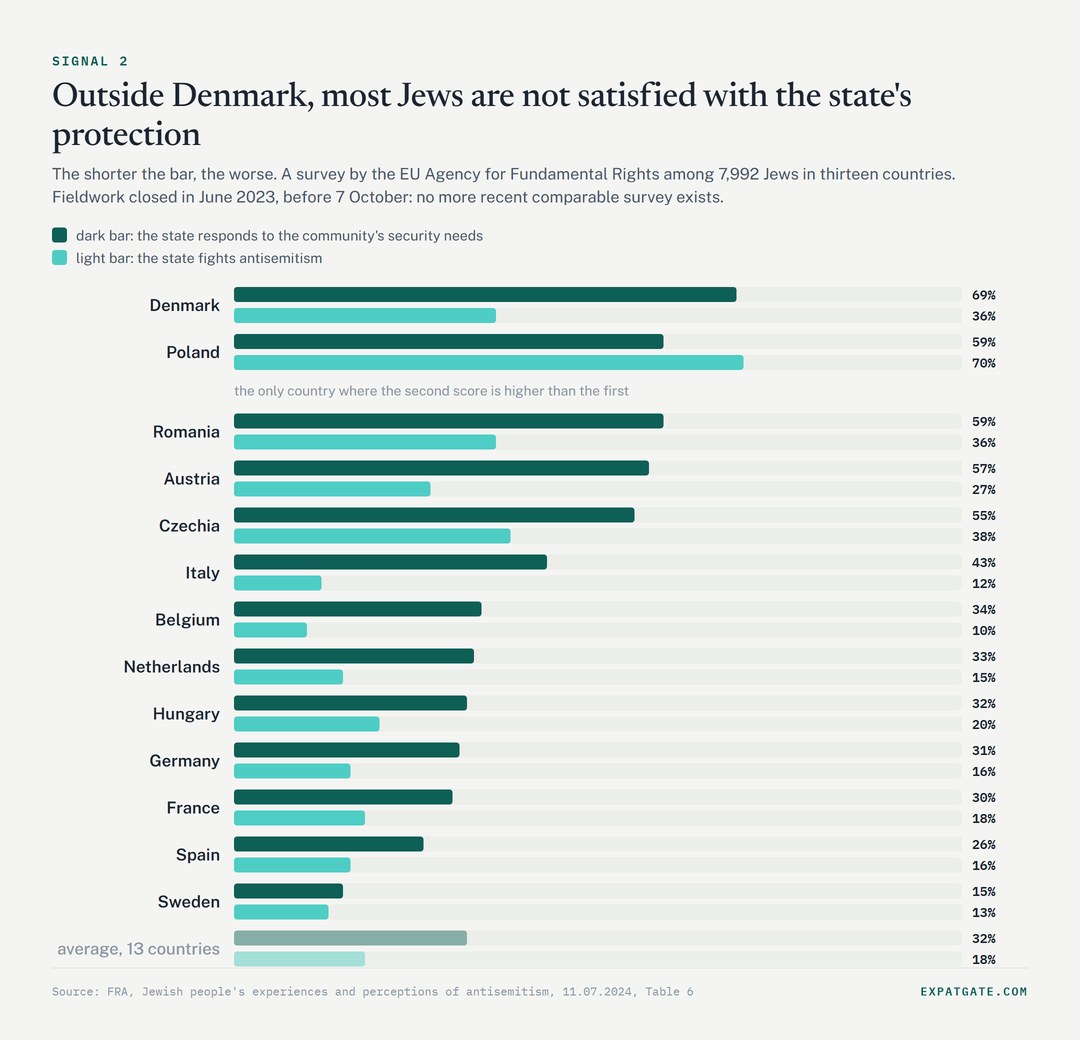
The figures next to that sentence are these. In the European survey 77% of Dutch Jews at least sometimes avoid wearing Jewish symbols, and 49% never wear them, for safety reasons. 78% feel they are blamed for Israel's actions. 39% have thought about leaving over five years, against 30% in the 2018 survey. And only 15% think the state fights antisemitism effectively.
The survey ran from January to June 2023, that is, before 7 October and long before the events in Amsterdam. There is nothing more recent that is comparable, and that in itself says something about how much attention the question gets.
Four signals that make this measurable at all
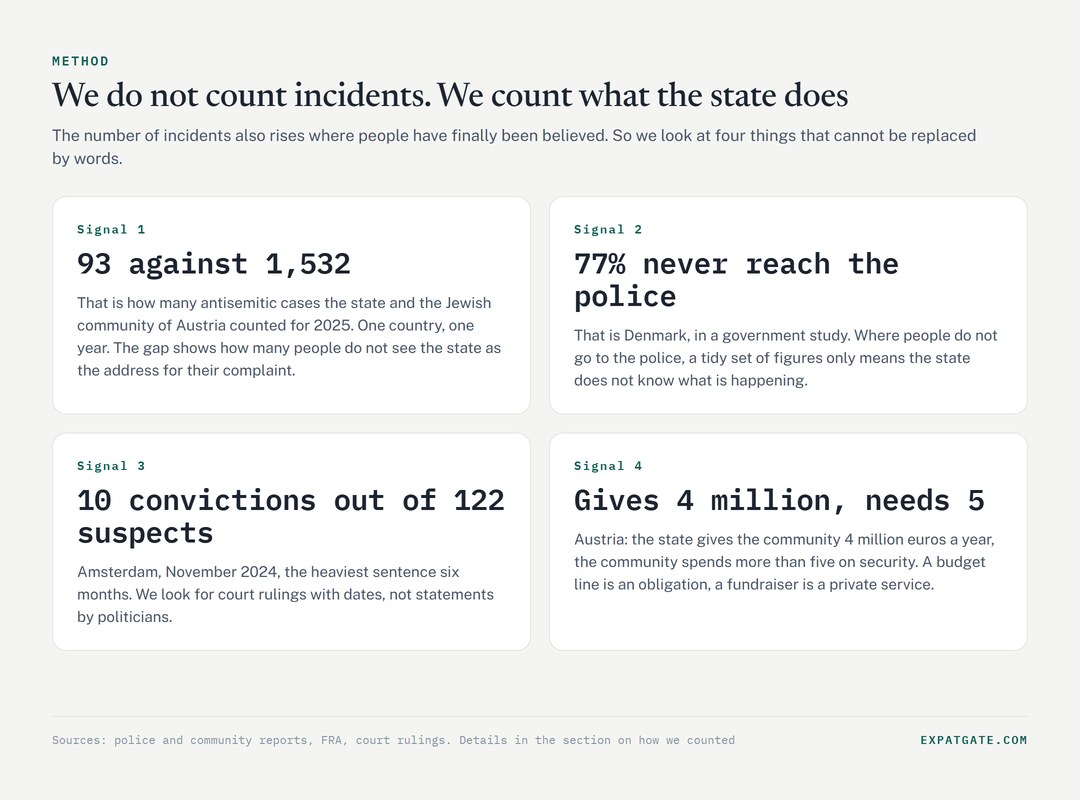
Austria, 2025: the state counted 93 antisemitic acts, and the Vienna Jewish community counted 1,532 cases for the same year. One country, one year, a sixteenfold difference.
The EU Agency for Fundamental Rights, which collects European data on antisemitism, writes itself that its data cannot be used to compare countries: the definitions differ, the completeness of recording differs, and a rise in numbers may mean that people have started reporting more rather than that there is more hatred.
So we do not line countries up by number of incidents. We look at the machinery: what the state does, who pays, whether a case reaches court, and whether the people it happened to believe in it.
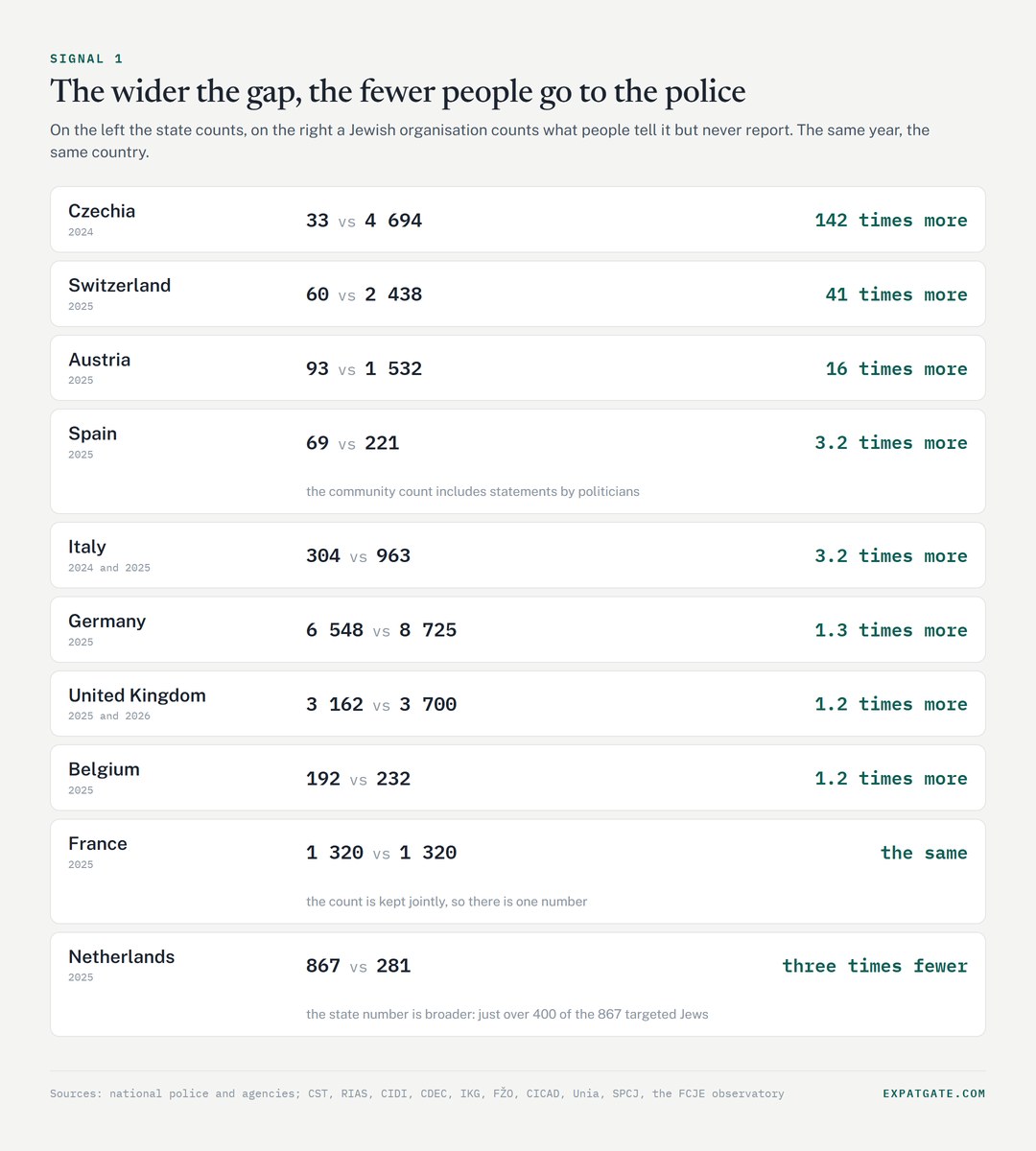
Signal 1. The gap between the two sets of statistics
Those same 93 and 1,532 are the first signal. The state counts what reached the police and the courts. Jewish organisations count everything people tell them about: calls, letters, school stories, cases after which the person went nowhere at all. We need both figures and the distance between them: it shows how many people do not see the state as the address for their complaint.
Signal 2. Who stays silent
77% of cases of shouting, threats, harassment and violence in Denmark never reach the police. That comes from a state study, not from a community complaint. A country can have statistics of any level of detail: it simply does not know what is happening. So each time we look at whether people were asked directly whether they reported the last incident.
Signal 3. What reaches a verdict
3.8%: that is the share of antisemitic offences in the United Kingdom in the year to March 2025 that ended in a charge or a court summons. The chain is simple: incident, report, case, charge, verdict, and at every link the numbers fall. What matters is how far. So we look not for politicians' statements but for judgments with dates.
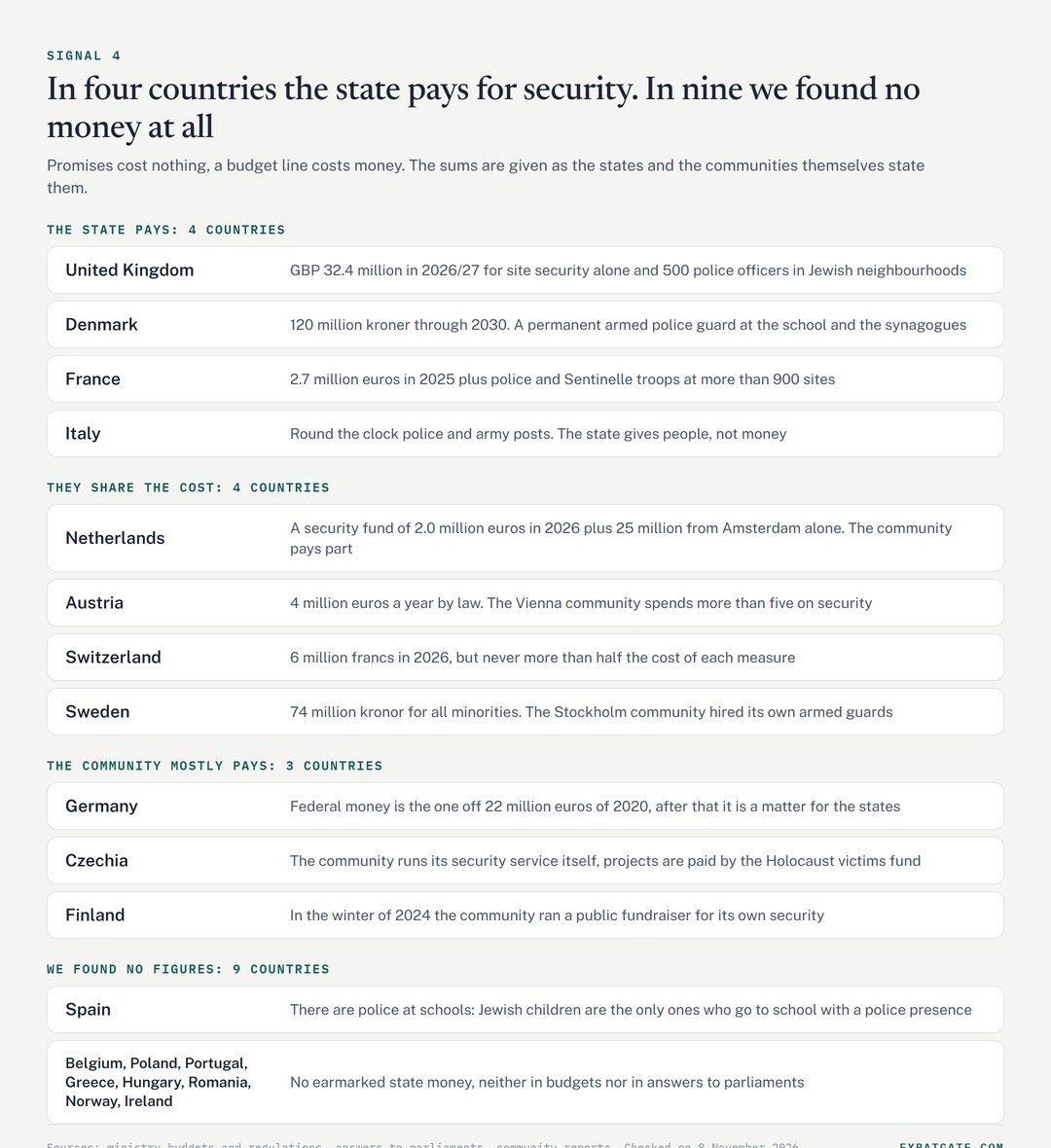
Signal 4. Who pays for security
Outside a Jewish school in Europe there is almost always a guard. The question is who pays for it. Where the state has taken security on itself and named a sum in the budget, that is an obligation. Where the community raises the money itself, safety turns into a private service that parents buy. The difference shows up in budget documents, and it is hard to replace with words.
What these signals do not catch: the mood of society, and individual attacks. They answer a narrower and more useful question: what the state does when something has happened, and whether the people it happened to believe in it.
Twenty countries
In Denmark 69% of Jews are satisfied with the way the state responds to the community's security needs. In Sweden, on the same question, 15%. A difference of four and a half times between two neighbouring countries in northern Europe, and the budget explains it less well than you would think.
The United Kingdom: the most expensive protection and the highest numbers
On 2 October 2025, on Yom Kippur, at 9:30 in the morning, a car drove at speed into the gates of the Heaton Park synagogue in north Manchester. The driver got out with two knives, wearing what looked like a suicide belt. Two worshippers died, Melvin Cravitz and Adrian Daulby. The coroner's inquest established that one was killed by the attacker's knife and the other by a bullet from police firing at the attacker. The attacker was not declared dead until 16:38, because of fears that the belt was real.
CST, the organisation of the British Jewish community, calls this the first fatal antisemitic terrorist attack in the United Kingdom in all the time it has been counting, since 1984. Exactly one year later, on 2 October 2026, two Iranian nationals were charged in connection with an alleged plan to attack the Jewish community of Manchester on the eve of the same holiday.
Britain is the extreme case: it has the worst statistics in Europe and the most developed state protection at the same time. CST counted 3,700 incidents in 2025, against 3,556 in 2024 and 4,298 in 2023. Before 7 October 2023 an ordinary year gave 1,662. The police of England and Wales registered 3,162 offences against Jews in the year to March 2026. For a population of 270 thousand that is the highest rate of any religious group in the country.
But the second number here matters more than the first. A charge or a court summons followed in only 3.8% of antisemitic offences. David Toube of the Jewish Leadership Council put it like this: failures of this kind create an environment in which hatred is permitted.
And the money is real. Guarding synagogues, schools and community centres is paid for out of the budget: the Jewish Community Protective Security Grant has run since 2015, the money is distributed by CST itself, and for 2026/27 the sum rose to 32.4 million pounds. In July 2026 the government added 251 million pounds over three years and more than 500 police officers specifically in Jewish neighbourhoods. Hamas has been banned in full since 26 November 2021, the terrorist threat level for the Jewish community has been raised to its highest grade, and antisemitism training has become compulsory for every police officer in England and Wales.
The head of CST, Mark Gardner, responded to that like this: the serious reinforcement came at the last moment.
What British statistics are actually made of can be seen in another number. In 2025 CST recorded around 70 cases of schoolchildren being targeted on the way home because their school uniform gave them away. Episodes like that usually have no criminal consequences. In a Campaign Against Antisemitism survey 59% of British Jews try not to show outward signs of belonging, and 61% have thought about leaving the country in the past two years.
Ireland: almost no attacks, and no protection as a system either
January 2025, the Holocaust Memorial Day ceremony in Dublin. President Michael D. Higgins speaks about Gaza in his address. Some of those present turn their backs on him in protest, and one participant, Lior Tibet, is escorted out of the event. There were no consequences for anyone. Tibet said afterwards that they are not listened to at all and that they feel unheard and invisible.
Ireland is often described as a calmer place for Jews. On our data that is true exactly by half. Physically it really is quieter. For 2023 to 2026 we found no fatal or serious antisemitic attack in Ireland. The police registered 15 antisemitic incidents in 2023 and 14 in 2024. The chief rabbi of Ireland, Yoni Wieder, says himself that since 7 October there have been substantially fewer incidents here than in Britain or France, and that the overwhelming majority of Irish Jews would call it a wonderful place to be Jewish.
The second half starts where the risk ends and the system begins. Ireland has no national strategy against antisemitism, no state recording of such incidents, no regular breakdown of police data and no earmarked money for guarding Jewish institutions. The country's first ever count was created by the community itself in mid 2025: 143 incidents in six months in a community of roughly 2,200 people, and only 24% of those affected went anywhere with it. We found no publicly known conviction in an antisemitic case, and there is no way to check: the state does not publish data on convictions for hate crime.
The third layer turned out to be the main one for Irish Jews, and it is not about the street. The recognition of Palestine in May 2024, support for the case against Israel at the International Court of Justice, the Occupied Territories Bill, the closure of the Israeli embassy in Dublin in December 2024: all of this the community read as a signal about its place in the country. The same Rabbi Wieder says politicians take almost no interest in how this lands on the Jewish community. And the chair of the Jewish Representative Council, Maurice Cohen, said of explanations along the lines of "this is a reaction to Gaza" that presenting hostility to Irish Jews as an understandable consequence of events somewhere else is blaming the victim, and that it is antisemitism.
Our conclusion on Ireland is this. The risk there is lower than in Britain, and Irish Jews confirm it themselves. But being protected is not only low risk, it is also what the state does if the risk grows. Ireland has no answer as a system right now, and there would be nothing to catch a rise.
Germany: the loudest words of all, and the Länder pay for security
On 2 February 2024 in Berlin a Jewish student at the Free University, Lahav Shapira, was brutally beaten. He suffered serious injuries to his face and head and later said he could have died. The court of first instance gave the attacker three years and recognised an antisemitic motive.
Then came the thing that matters more in Germany than the sentence. The Berlin regional appeal court on 13 April 2026 cut the term to two years and six months and found the antisemitic motive unproven; the prosecution service filed a further appeal. In parallel, the Berlin administrative court on 23 March 2026 dismissed Shapira's claim against the university: the university's duty to combat discrimination does not create a right a student can enforce in court. He has gone to university with personal security ever since.
In words Germany goes further than anyone in Europe. The government commissioner Felix Klein, at the publication of the RIAS report for 2025, said antisemitism is advancing with no brakes and threatens not only Jews but democracy, freedom and the moral core of the republic. Interior minister Alexander Dobrindt the same day named the three sources Germany officially recognises: right-wing, left-wing and imported extremism.
The numbers behind those words are these. The police (politically motivated crime statistics): 2,641 cases in 2022, 5,164 in 2023, 6,236 in 2024, 6,548 in 2025. The RIAS association, which keeps the community count: 2,480, 4,886, 8,627 and 8,725 for the same years.
The difference between 6,548 and 8,725 is what lies below the threshold of criminality: the state neither records nor prosecutes those cases. The president of the Central Council of Jews, Josef Schuster, converted it into units anyone can grasp: twenty four cases a day.
Germany's laws are tough. On 2 November 2023 the interior minister banned the activity of Hamas and dissolved the Samidoun network. The symbols of banned organisations, including slogans and salutes, are punishable under §86a of the Criminal Code by up to three years.
And the money for security falls apart. In its answer to a Bundestag question of 16 December 2025 the government names as the only federal sum the same 22 million euros allocated once in 2020 after the attack on the synagogue in Halle, and writes plainly that protecting Jewish institutions is the Länder's own task. Police stand outside synagogues, in the agencies' own wording, regularly or irregularly, and some communities pay for security themselves.
A separate German story is education. RIAS counted 450 antisemitic cases at universities in 2024, against 151 the year before, and 284 cases in schools where Jewish children were excluded from the group and made responsible for the war.
In the EU survey 80% of Jews in Germany at least sometimes avoid wearing Jewish symbols in public, and 51% have thought about leaving the country over five years. The survey was collected from January to June 2023, that is, before 7 October; there is nothing more recent that is comparable in Europe.
Austria: there is a strategy, there is no count, and the community pays for itself
The president of the Vienna Jewish community, Oskar Deutsch, named a figure on 23 April 2026: the community spends more than five million euros a year on its own security, because Jewish life is only possible with extensive security measures. By law the federation pays the Jewish community of Austria 4 million euros a year. The community spends more on security than it receives from the state for everything.
And yet Austria was the first in the European Union to adopt a national strategy against antisemitism, and it is proud of that. In November 2025 its second version came out, for 2025 to 2030, with 49 measures. State secretary Alexander Pröll spoke at its presentation about a new wave of antisemitism, more open and more uninhibited in the digital environment, and about how only a society that protects Jewish life preserves itself.
Checking those words against figures is next to impossible. The country has no separate state statistics on antisemitic offences: such acts are published inside the section on right-wing extremism of the constitutional protection report, and there for 2025 stand those same 93 acts. The Vienna community has 1,532 cases, and Middle East related antisemitism is counted in yet another category. Austria itself named systematic recording as the first task of the new strategy, so the authorities acknowledge the problem.
How the community's count is built can be seen in the first half of 2025: 726 cases, of them 5 physical attacks, 8 threats, 78 instances of damage to property, 203 mass mailings, 432 cases of offensive behaviour. In 77 cases there was a call for terror against Jews or the glorification of it. How many of them reached court nobody knows: there is no such data.
How an Austrian case ends can be seen in one story. On the night of 1 November 2023 a room in front of the ceremonial hall in the Jewish section of Vienna's Central Cemetery was set on fire and swastikas were painted on the walls. The suspect was identified from overalls, a spray can, DNA and phone data, charges were brought, and on conviction he faced 10 to 20 years. The trial was set for 9 December 2025, but in early December it was taken off the list: the summons could not be served on the defendant. For the justice system he turned out to be unreachable. There is still no verdict.
In one place Austrian law is ahead of almost all of Europe. Hamas symbols are explicitly banned by the Symbols Act from 1 March 2019, four years before 7 October 2023, alongside the symbols of the Muslim Brotherhood, the PKK and the Grey Wolves.
France: soldiers outside synagogues and verdicts that still cannot keep up
On 15 June 2024 in Courbevoie near Paris three teenagers took a twelve-year-old girl into a disused nursery, insulted her, beat her and raped her; one of them filmed it. On 13 June 2025 the juvenile court gave two of them nine and seven years in prison. The presiding judge said it plainly: she would not have been attacked had she not been Jewish.
France is home to the largest Jewish community in Europe, around half a million people. And it is the only country where our first signal does not work: state and community statistics match to the single case. That is by design. The Jewish community's protection service SPCJ has been an official partner of the interior ministry since 2004 and prepares its annual report together with the territorial intelligence service.
So there is one figure: 436 acts in 2022, 1,676 in 2023, 1,570 in 2024, 1,320 in 2025. Jews are less than 1% of the French population, and antisemitic acts make up more than half of all acts against believers.
Protection here is physical and visible. Police, gendarmes and soldiers of operation Sentinelle stand outside Jewish sites: in November 2023 the interior minister spoke of 10 thousand personnel at more than 900 sites. The state programme for the security of places of worship gave 3.7 million euros in 2025, of which 2.7 million went to Jewish sites. Before every Jewish holiday separate instructions go out to prefects.
Serious cases do reach court, and the sentences in them are hard. On 22 March 2025 in Orléans Rabbi Arié Engelberg was beaten while walking home with his nine-year-old son; a month later a sixteen-year-old received 16 months in prison, a five-year ban on appearing in the department and a three-year ban on contacting the rabbi and his family. On 17 May 2024 in Rouen an armed man set fire to a synagogue and was shot dead by a police officer at the scene.
The complaint of French Jews is not that they are not guarded but that guarding does not replace justice. CRIF president Yonathan Arfi said in February 2026 that antisemitism has no truce and that the hatred growing in the country is a French problem. He also faults the courts for not calling antisemitism antisemitism unless the offender declared it himself.
The gap is clearest in schools. For the 2024/25 school year the education ministry received 1,668 reports of antisemitic incidents in schools. Police statistics on schools recorded 192. SPCJ is asking for school reports to be passed systematically to the interior ministry: that does not happen now, which is why the two figures differ by a multiple.
Belgium: impeccable words from ministers and 10% trust
Only 10% of Belgian Jews answered in the European survey that the government fights antisemitism effectively. The worst result of the thirteen countries, where the average is 18%. In the same survey 97% said they had encountered antisemitism in daily life over the past year.
There are roughly 34 thousand Jews in Belgium, mostly in Antwerp and Brussels. The authorities' words, meanwhile, are impeccable. Prime minister Bart De Wever said at a commemoration in Antwerp in May 2025 that pictures from the Middle East are used to identify Jews with evil.
On 9 March 2026 at around four in the morning an explosive device went off outside the synagogue on Rue Léon Frédéric in Liège. The front window was destroyed and windows in the houses opposite were blown out; nobody was hurt. The federal prosecution service took the case, several people were detained, and an Islamist group linked to Tehran claimed responsibility. Interior minister Bernard Quintin called the blast a cowardly antisemitic act aimed directly against the Jewish community of Belgium.
Now the mechanics. Soldiers stood outside Belgium's Jewish sites from 2015, after the shooting at the Jewish Museum in Brussels that killed four, and were later withdrawn. They came back on 16 March 2026, a week after the explosion in Liège, by decision of two ministers. Which means protection in Belgium is not a permanent line but a response to an event.
Belgium has no national plan against antisemitism, no national coordinator and no public court statistics on antisemitic cases. We found no verifiable convictions. The one court outcome in a high-profile case that we know of goes the other way: a court acquitted a Flemish writer whose column the community considered hateful.
Italy: round-the-clock posts outside synagogues and a rising number of attacks
The president of the CDEC foundation, Giorgio Sacerdoti, wrote in his introduction to the 2025 report that a sense of being unprotected is spread through the community, and that the presence of police outside synagogues and schools does not remove it but in a sense even sharpens it.
That was said about the most visible security system in Europe. Italy's synagogues, schools, kindergartens, museums and cemeteries stand under permanent police and army posts under operation Strade Sicure, which has run since 2008. Money the state does not give the community: it gives people.
The statistics are double and differ threefold. The interior ministry, through its OSCAD structure, counted 94 cases in 2022, 316 in 2023 and 304 in 2024. The CDEC foundation, which has kept a count since 1991, counted 241, 453, 877 and 963 for 2022 to 2025. On the quality of that count: out of 1,492 reports received for 2025, CDEC recognised 963 as antisemitic, which is to say it filtered out a third itself.
The worrying line in Italy is not the total but physical attacks: 2 cases in 2023, 8 in 2024, 18 in 2025. On 10 November 2025 on a platform at Milan Central station a man beat an American Orthodox Jew from a tourist group, striking him on the head with an iron ring; a railway police patrol detained him within minutes. On 16 September 2026 in Milan three young men tore the kippah off the rabbi of the Milan community and kicked him. On the night of Yom Kippur, 21 September 2026, two "stumbling stones" commemorating people murdered at Auschwitz were covered in paint in the colours of the Palestinian flag in Rome; the same stones had been targeted by arson in 2023.
Giorgia Meloni on Holocaust Memorial Day 2026 called antisemitism an affliction that is spreading again in new and malignant forms. Italy has no separate law on antisemitism; the Mancino law of 1993 applies. There are convictions for statements: on 13 October 2025 an activist was given a year and six months for an antisemitic video on Instagram. And a foreign national who in October 2026 spread propaganda in support of Hamas's military wing and calls for violence against Jews on social media was not tried by Italy but expelled from the country on state security grounds.
Spain: few attacks, and the pressure comes from above
The president of the federation of Jewish communities of Spain, David Obadia, said on 2 September 2026: our children are the only ones who go to school with a police presence.
Official antisemitic offences in Spain are very few: the interior ministry counted 13 cases in 2022, 23 in 2023, 37 in 2024 and 69 in 2025. Of the 69, 34 were solved and 14 people were charged. That is an order of magnitude less than its neighbours, and physical violence there really is rare: the man who attacked a kosher pizzeria in Madrid was found within a month.
The observatory of the federation of Jewish communities counts differently: 34, 60, 193 and 221 cases for the same years. That observatory works by the IHRA definition and puts into its statistics, among other things, statements by serving members of the government, cartoons in major newspapers and decisions of municipalities. Which means Spanish figures measure political speech, more than Italian or German ones do, rather than street attacks. We give both figures and say what each one is made of.
But there is also what does not fit inside that caveat. In December 2025 a poster campaign ran in Barcelona with the words "Zionists out of our neighbourhood", and on 31 December an online platform went live marking Jewish and Israeli shops in the city. On 8 February 2026 it was still working. Refusal of service became a story of its own: a "we do not serve Zionists" notice in Bilbao, "Zionists not welcome" at a Madrid market, women with Jewish symbols escorted out of the Reina Sofía museum.
And one court outcome worth knowing before you move: on 26 November 2025 a judge dropped the case against the owner of an establishment in Vigo who threw a group of Israelis off his terrace.
Spain has had a national plan against antisemitism since January 2023. No new laws have been passed since 2023, and the main legislative event of these years points in the other direction: on 23 September 2025 the government adopted a decree law "on urgent measures against the genocide in Gaza", banning arms exports to Israel. The word "genocide" stands in the title of an official act. For Spain's Jewish community it is that, rather than street violence, that sets the sense of their place in the country.
Next come the east and the north of Europe, where the picture turns over: there is less street violence, and state recording either does not exist at all or produces figures the community itself does not believe.
Czechia: by Jews' own account the calmest country in Europe
In the survey of the EU Agency for Fundamental Rights Czech Jews gave the best figure of the thirteen countries on every question. Very worried about being attacked: 5% (the survey average is 44%). Very worried about harassment: 11% (average 53%). Thought about emigrating over five years: 18% (average 45%). At least sometimes avoid wearing Jewish symbols: 54% (average 76%).
The Federation of Jewish Communities writes itself that compared with other countries Czechia remains a safe country for the community.
The numbers are rising here too. The police record dozens of antisemitic offences a year (18 in 2023, 33 in 2024), while the Federation of Jewish Communities counted 4,328 cases for 2023 and 4,694 for 2024. The hundredfold difference comes down to method: what goes into the community count is above all statements on the internet.
Physical attacks, though, are counted there one by one: four cases in 2024, against two in the previous four years put together.
On 29 January 2024, shortly after midnight, two teenagers placed a lit canister of flammable mixture at the entrance of the Agudas Achim synagogue in Brno. The device did not go off. The police classified it as an attempted terrorist attack, five people aged 13 to 18 were detained in an international operation, and two were charged, including with support and propaganda for terrorism.
On 22 October 2025 the government adopted a strategy for fighting antisemitism for 2025 to 2030. The Federation of Jewish Communities replied that it would be naive to think one strategy will stop the current tsunami of anti-Jewish hatred.
Poland: little street violence, a great deal of politics
On 12 December 2023 Sejm deputy Grzegorz Braun put out Hanukkah candles in a parliament corridor with a powder fire extinguisher and shoved a woman who tried to stop him. The video went round the world. On 17 January 2024 the Sejm stripped him of immunity on seven counts at once.
As of 8 November 2026 there is no verdict. Hearings on 30 October and 6 November 2026 were cancelled on the defendant's medical certificate, and on 16 October the judge removed him from the courtroom. A sentence, even a suspended one, once it takes effect will close his path to standing for the Sejm.
After that he became a member of the European Parliament. In July 2025, during the anniversary of the Jedwabne pogrom, he said on the radio that ritual murder is a fact and that Auschwitz with its gas chambers is a fake. The European Parliament stripped him of immunity twice. The prosecution service in Wrocław, on 26 October 2026, after five failed attempts, brought six charges against him, one of them for incitement to religious hatred. He denied guilt and called the proceedings a state lynching. In the 2025 presidential election he came fourth with 6.3% of the vote.
Prime minister Donald Tusk reacted to the words about Auschwitz briefly: it is a disgrace, and we must do everything so that Poland is not associated anywhere in the world with faces like that. Foreign minister Radosław Sikorski said that Holocaust denial excludes a country from the ranks of civilised nations.
Antisemitic street violence in Poland really is limited. About seven thousand Jews live in the country; in the EU survey 4% of respondents had been attacked over five years, and 16% noted an effect of the Middle East conflict on their own sense of safety, against an EU average of 62%.
The state machine has been reinforced since 2025: instructions from the prosecutor general on bias-motivated cases, 50 specialised prosecution offices and around a hundred dedicated prosecutors since February 2026, and the share of cases reaching court up from 17% to 25%. Poland has no national coordinator on antisemitism, no separate community count of incidents at the moment either, and who pays to guard synagogues could not be established from open documents. The complaint of human rights advocates is not about the laws but about enforcement: cases where the police refused to take a report, saying there was no offence here.
And two figures worth holding side by side. The Polish police only began counting bias-motivated offences in 2026: in the first half of the year, out of 655 bias-motivated offences, 59 were antisemitic. And a CBOS survey in February 2026 showed that dislike of Jews in Polish society had risen to 40%, up eight points in a year, while warmth had fallen to 22%, the lowest since 2006. There is little street violence, but the background is changing, and changing fast.
Hungary: the best protected community and the highest level of prejudice
Hungarian Jews are less afraid than almost anyone in Europe: 12% are very worried about being attacked, 2% had been attacked over five years, and only 9% think the Middle East conflict affects their safety, the lowest figure in the survey.
Entrenched antisemitic attitudes, by the ADL index, are held by 37% of adult Hungarians. The highest result among the European countries surveyed.
Both numbers are true at once. Viktor Orbán wrote in January 2024 that Hungary had become one of the safest countries for the Jewish community. The chief rabbi of the EMIH union, Slomó Köves, speaks in the same vein: Hungary has become a model country of Jewish revival and of zero tolerance for antisemitism.
And next to that stands an episode there is no way round. On 6 July 2017 the then president of the Mazsihisz federation, András Heisler, asked Orbán to stop the poster campaign against George Soros, because it could awaken antisemitic emotions among other things. The Israeli ambassador asked the same. Orbán refused in a letter in which he wrote that only Hungarians can decide whom they want to live together with and whom they do not.
And only 20% of Hungarian Jews think the government fights antisemitism effectively. Which is to say the state protected the community as an institution and was proud of it, while that same state's own political campaign used images in which the community recognised old motifs.
Acting fast is something this state can do: in July 2025, after protests by Jewish organisations, an Irish rap group invited to a major festival was banned from entering the country over antisemitic hate speech and the glorification of terrorists. This was reported by the newspaper Magyar Nemzet; we found no official announcement with a legal basis and a term for the ban. And on 30 October 2026 the organisation TEV reported that a Hamas fighter killed in Gaza had been receiving a Hungarian state scholarship of almost 2 million forints; TEV's enquiry to the foundation that distributes the scholarships was unanswered as of our date.
An important caveat about how current this is. After the election of 12 April 2026 the Hungarian government changed: on 9 May Péter Magyar became prime minister. Everything said here about Orbán refers to the previous government. The new one has declared continuity: in July 2026 minister Zoltán Tarr spoke of zero tolerance for antisemitism. The post of commissioner against antisemitism was created by the previous cabinet on 25 May 2025, and who holds it now we could not establish from open sources. The Hungarian part of the picture is the most fluid in the whole guide, and it is worth rechecking.
For someone choosing a country there is one conclusion: a low risk of being attacked in the street goes together here with a high background of prejudice, and the first does not cancel the second.
Denmark: the state pays for armed protection and does not argue about it
On 28 February 2025 a Jewish woman told some friends that she finds it hard that there are police outside her children's school every day. One friend replied that this is understandable and necessary, but that they have themselves to blame, if you think about what is happening in the Middle East. The other asked why she feels unsafe, given that the politicians are on their side and the police protect them, and nothing serious has happened apart from 2015.
That conversation is entered in the Danish community count as incident number 36 of 2025. There is no criminal case here and there cannot be. But in it you can see everything at once: the security regime at the school, and how the people around it look at that regime.
Denmark gives the clearest answer in Europe to the question of who pays. The Carolineskolen Jewish school, the community office and the synagogues in Copenhagen are under permanent armed police protection at the state's expense. The 2026 budget has a separate line for guarding Jewish institutions.
And the "2015" the friend mentioned is 14 February, when the community's volunteer guard Dan Uzan, 37, was shot dead outside the synagogue on Krystalgade. He was on duty at a bat mitzvah. A few hours earlier the same man had opened fire at a debate on free speech at a cultural centre. The whole Danish security system is built from that day on.
On 25 June 2024 the Folketing, unanimously, the government and eight parties, adopted an agreement on strengthening the fight against antisemitism. The first line of the document: "Jøder i Danmark skal kunne leve i tryghed" (Jews in Denmark must be able to live in safety). It also records something states do not usually write about themselves: offences should be reported to the police, and the authorities should treat those reports with the utmost seriousness.
At the same time the numbers in Denmark are the highest in northern Europe per head: the police registered 37 cases flagged "Judaism" in 2022, 171 in 2023, 222 in 2024 and 294 in 2025, in a community of roughly 8 thousand people.
And a Danish figure shows why a second count is needed. In a study by the Institute for Human Rights published on 20 September 2025, 77% of cases of shouting, threats, harassment and violence never reach the police, and only 17% of those affected report to the community count. 62% of respondents hide Jewish symbols, and 36% have thought about leaving the country.
Sweden: the money is there, the trust is not
On 7 February 2026 Stockholm police moved a weekly anti-Israel rally to the Raoul Wallenberg memorial, roughly fifty metres from the Great Synagogue of Stockholm. It used to be held on a square a kilometre and a half away. The chair of the Jewish Central Council, Aron Verständig, was told by the police that other demonstrators had taken the old spot and needed the space. To journalists the police gave no reasons.
Sweden shows that budget and trust are different things. The state acts systematically: a ten-year national strategy for 2025 to 2034, a national coordinator, a state Holocaust museum, a security grant of 74 million kronor a year for minority organisations and additional earmarked money for the Jewish community.
Prime minister Ulf Kristersson said at a rally against antisemitism in December 2023 that no Jew in Sweden should have to ask whether they dare go on living in their own country. And he immediately drew the line we try to hold in this guide: holding different views about the conflicts over there is legitimate, spreading antisemitism here is not.
And Swedish Jews' rating of their state is the lowest in Europe: 15% on the question of how the state responds to the community's security needs. That is a different question from the Dutch 15% about the effectiveness of the fight against antisemitism, and the coincidence of the numbers is accidental.
The community drew its own practical conclusion: the Jewish community of Stockholm hired its own armed guards, including people from Israel, and obtained weapons permits for them. State figures for 2024 are almost twice those for 2022: 217 reports against 111. Sweden has no permanent community count of incidents of its own, so there is no second number to check the first against.
The most recent Swedish story is dated 6 November 2026. Halimo Nuur Bashir Abdi became the Malmö city councillor responsible for human rights and for work against antisemitism and racism. According to the newspaper Expressen, she had shared a post saying there is no democracy in the western world, expressed understanding for the Hamas attack in 2023, and shared a post claiming, with reference to the Epstein case, that the world is ruled by "satanic paedophiles". The organisation SKMA stated that she is extremely unsuited to leading this work. We found no response either from the city or from the councillor herself.
Malmö is not a random city here: the community there has been shrinking for decades, and some of its young members have left. Antisemitism its representatives name as one of several reasons, alongside work and the wish to live in a large community.
Norway and Finland: the argument is not about money but about words
On 27 March 2025 the leaders of both Jewish communities in Norway sent the health authorities a letter they themselves called unprecedented. Community members hide their identity in medical settings and fear they will not get proper care if they disclose that they are Jewish. The letter says there has been no situation like this since the Second World War.
Dr Rolf Kirschner described it concretely: people do not dare put on a Star of David when going for an examination, and they are afraid their name will be said out loud in the waiting room. The documented approaches in the letter number five or six, and the author himself speaks of them as a sign of a wider picture rather than as a full count. The health minister replied that all patients must feel safe, and called creating that atmosphere the responsibility of the medical institutions themselves.
Around 1,400 Jews live in Norway, and roughly the same number in Finland. Both countries run careful state policy. Norway's national plans against antisemitism have run back to back since 2016; the current one covers 2025 to 2030 and contains 22 measures. Prime minister Jonas Gahr Støre, presenting it in November 2024, said of the Jewish minority's position that it is more serious than it has been for a long time, and compared antisemitism to a canary in a mine.
But the conflict between community and state in both countries runs somewhere else.
On 21 April 2026 a professor at Norway's largest university called the mass killings of 7 October 2023 the most beautiful thing that has happened in our century. On 7 May the rector told NRK that the professor's views do not represent the university, but that freedom of expression in Norway is strong and that he is not planning disciplinary measures; the university has no written rules about how staff express themselves. Hamas is not recognised as a terrorist organisation in Norway at all.
In Finland the argument is about one address. Since November 2024 there have been practically daily demonstrations outside the Jewish community centre on Malminkatu in Helsinki. That building holds the city's only synagogue, a kindergarten, a preschool group and a school from the first to the ninth grade. According to the complaint of the Central Council the messages were addressed to Jewish children and community members and were shouted from a distance of 30 to 40 metres.
Helsinki police decided not to open an investigation, finding no offence. The interior ministry, in a reply of 2 December 2024, pointed above all to the constitutional right of assembly. On 20 October 2025, when the demonstrations had been going for almost a year, the Central Council filed a formal complaint about the police's conduct with the parliamentary ombudsman. There is no separate state sum for security there: in December 2024 the Jewish community of Helsinki launched a public fundraiser for its own safety.
Finance minister Riikka Purra said at a ceremony commemorating the eight Jewish refugees Finland handed over to Nazi Germany that it is the duty of the Finnish state to protect Jewish life in Finland and not to allow the dark chapters of the 1930s and 1940s to repeat. The words are right. The kindergarten, meanwhile, remains behind the line of a daily demonstration.
And the Finnish figure that explains why statistics are useless here. In the country's first ever study of Jews, 83% think antisemitism has grown over five years and 70% reported being blamed for the Israeli government's actions. Yet only 8% of those who met discrimination reported it to the police or a supervisory body, and that with high trust in the authorities and the legal system among the respondents. People believe the state and still do not go. The data was collected in October and November 2023, that is, immediately after 7 October.
Switzerland: the money grew twelvefold, and counting never started
On 2 March 2024 in Zurich a fifteen-year-old attacked an Orthodox Jew with a knife and seriously wounded him, live streaming it as he did. According to the indictment he radicalised online and swore allegiance to ISIS. He first tried to get into a synagogue in order to kill Jews, but the doors were locked.
On 1 July 2026 the juvenile court found him guilty of multiple attempted murder, support for a terrorist organisation and incitement to hatred. The punishment was one year: the maximum for a person who was under sixteen at the time of the act. It was replaced with placement in a closed institution. The judgment has been appealed and cannot be called final.
Switzerland is the only country on our list that banned Hamas by a separate law of its own. The federal act was passed on 20 December 2024 and has been in force since 15 May 2025, and only for five years, until May 2030, unless parliament extends it. Switzerland deliberately keeps no general list of terrorist organisations, which is why the ban had to be written as a separate law.
The money for security grew in steps: up to 500 thousand francs a year in 2020 to 2022, 2.5 million from 2023, 5 million in 2024 and 2025, 6 million for 2026 and 2027. The federation, though, pays no more than half the cost of a measure; the rest is on the cantons and the community itself.
And counting antisemitism Switzerland never learned to do. There are no nationwide state statistics, motive is not recorded in police statistics, and the Federal Council itself acknowledged substantial gaps in August 2025. Instead of one figure the country has three: the federal commission's advice network counted 60 cases for 2025, the SIG association together with the GRA foundation 177 cases in the real world, and the organisation CICAD, for the French-speaking part of the country alone, 2,438 cases. The gap comes from different methods and from the fact that CICAD does not pass its data to the state network.
What Swiss daily life is made of can be seen in the 2025 report. In August a hotel in the canton of Graubünden turned away Jewish tourists, and a member of staff said it plainly: we do not rent rooms to Jews. In October at a school in the canton of Zurich pupils gave a Jewish classmate the Hitler salute several times, shouted "Kill the Jews" and called themselves Jew hunters. The report records no outcomes in these cases.
The heads of SIG and GRA wrote in the foreword to the annual report that if politics and society accept a certain amount of antisemitism as normal and inevitable, that leads in a dangerous direction.
Greece: the state sees almost nothing
For 2024 the Greek police recorded four antisemitic incidents. The OSCE database for the same year has seventeen, fourteen of which were submitted by the Central Board of Jewish Communities itself. For 2023 the police recorded not a single case of violence with an antisemitic motive.
Now what was happening in the country over that time. On 28 March 2023 an attack on a Chabad house with a kosher restaurant in central Athens was prevented: on a tip from Israeli intelligence two men from Pakistan were detained who, according to the case file, were in constant contact with a handler in Iran and, having failed to obtain weapons, planned to blow up the restaurant with gas canisters. On 15 May 2024 a building housing a hotel and a restaurant with Israeli involvement was attacked with an improvised incendiary bomb. On 18 June 2024 two people on a motorcycle set fire to the entrance door of a synagogue in Athens. Seven people were detained in the latter two cases; the sources available to us give no court outcomes.
There are around four thousand Jews in Greece. The feature the community itself points to: the pressure comes not from neo-Nazis (the appeal court upheld the Golden Dawn verdict on 3 March 2026) but from organised groups of the far left, and it is aimed above all at Israeli tourists and people speaking Hebrew.
On 27 June 2026 members of an anarchist group walked an "anti-Zionist patrol" through central Thessaloniki in black T-shirts with the Palestinian flag, explaining their choice of district by saying that Israeli capital had parasitically invaded it. The Central Board wrote at the time that it observes with sorrow the tolerance shown by the authorities of the state.
The state's response is worth writing down next to that, because it did happen. Thessaloniki police called the march a march with a racist motive, a special unit identified the participants, and on 24 August 2026 six Greek citizens aged 21 to 46 were charged with incitement to violence on a racist motive and with membership of a criminal organisation. There was no violence during the march itself. Greece can ban events too, but it does that without going through a link to terrorism: on 16 October 2025 the police banned an event on Syntagma Square set for the anniversary of the death of the Hamas leader, citing a serious threat to public safety.
Portugal: there is no data at all, and that is an answer in itself
Portugal is the country about which the most honest thing to say is that we do not know. There is no state recording of antisemitic incidents. Jewish organisations have no monitor of their own. There are no surveys of Jews about their sense of safety. There are no sums for security: in reports on France, Germany and Belgium the paragraph about police outside synagogues is standard, and in Portuguese reports it is absent altogether. We found no convictions in antisemitic cases, not one, and the US State Department writes plainly that the authorities rarely apply the relevant articles.
But one story there did reach a prosecutor, and it got there from an unexpected direction. On 6 August 2026 the office of the secretary of state for higher education sent the prosecutor general a document asking for an investigation into suspicions of antisemitism and incitement to hatred at the University of Coimbra. According to that document, from at least July 2024 to May 2026 posters, stickers and graffiti were put up in several faculties, including the words "Zionists should carry a certificate to prove they're human" and "Beware of Zionists". A doctoral student, Bar Harel, according to the document, received death threats, including the phrase "your family deserves a second Holocaust", and was physically attacked over a small Israeli flag on his backpack. This is an account of the submission, not a fact established by a court. The university stated in a reply to the Lusa agency that help had been given immediately and the complaints examined, but gave no specifics.
The loudest Portuguese story of recent years, meanwhile, is not about street antisemitism but about the state and the community. On 11 March 2022 the judicial police searched the Porto synagogue and detained the chief rabbi in a case about Sephardic ancestry certificates. There is no verdict, and the coercive measures were lifted in the autumn of 2022. The community calls this the use of accusations for political ends; the state calls it an investigation into document forgery and money laundering. The Sephardic route to citizenship itself was abolished by Organic Law 1/2026.
None of this means it is dangerous there, and none of it means it is safe. The president of the European Jewish Congress said in October 2023 that the Portuguese authorities are doing everything well and that there are no complaints. That is data too, and we have no other.
Romania: there are convictions, and the statistics do not show them
On 18 March 2025 a Jewish cemetery in Bacău was daubed with fascist and antisemitic symbols. The same man had put the same symbols on a car and on a wall in the town two weeks earlier. On 12 June 2025 the case went to court, and on 11 May 2026 the culprit received a year and two months in prison, suspended with two years of supervision: for destruction of property, public use of fascist symbols, desecration of graves, desecration of a place of worship and public use of antisemitic symbols.
On 29 August 2024 a member of a far-right association stuck stickers with Legionary Movement symbols on the entrance doors of a synagogue in Bucharest. He was detained on the spot by a special gendarmerie unit, and on 5 September 2025 a court sentenced him to a suspended year.
Which is to say that in Romania a case does reach a verdict, and that is a rarity in this material. The country has one of the most detailed laws against antisemitism in Europe, law 157/2018.
And now what does not square with that. In the data Romania submits to the OSCE there stands one antisemitic offence a year for 2022, 2023 and 2024. The OSCE writes plainly that Romanian recording does not separate hate crime from the rest. At the same time, in the words of the prosecutor general, the average number of cases rose from 21 a year up to November 2024 to 682 after it. The Romanian machine works in jerks and leaves almost no trace in the statistics.
What society itself thinks and where people are going
In Portugal the share of people who consider antisemitism a problem in their own country rose by 23 points over seven years, in Ireland by 20, in Italy by 15. The topic grew most where it had not been heard at all before.
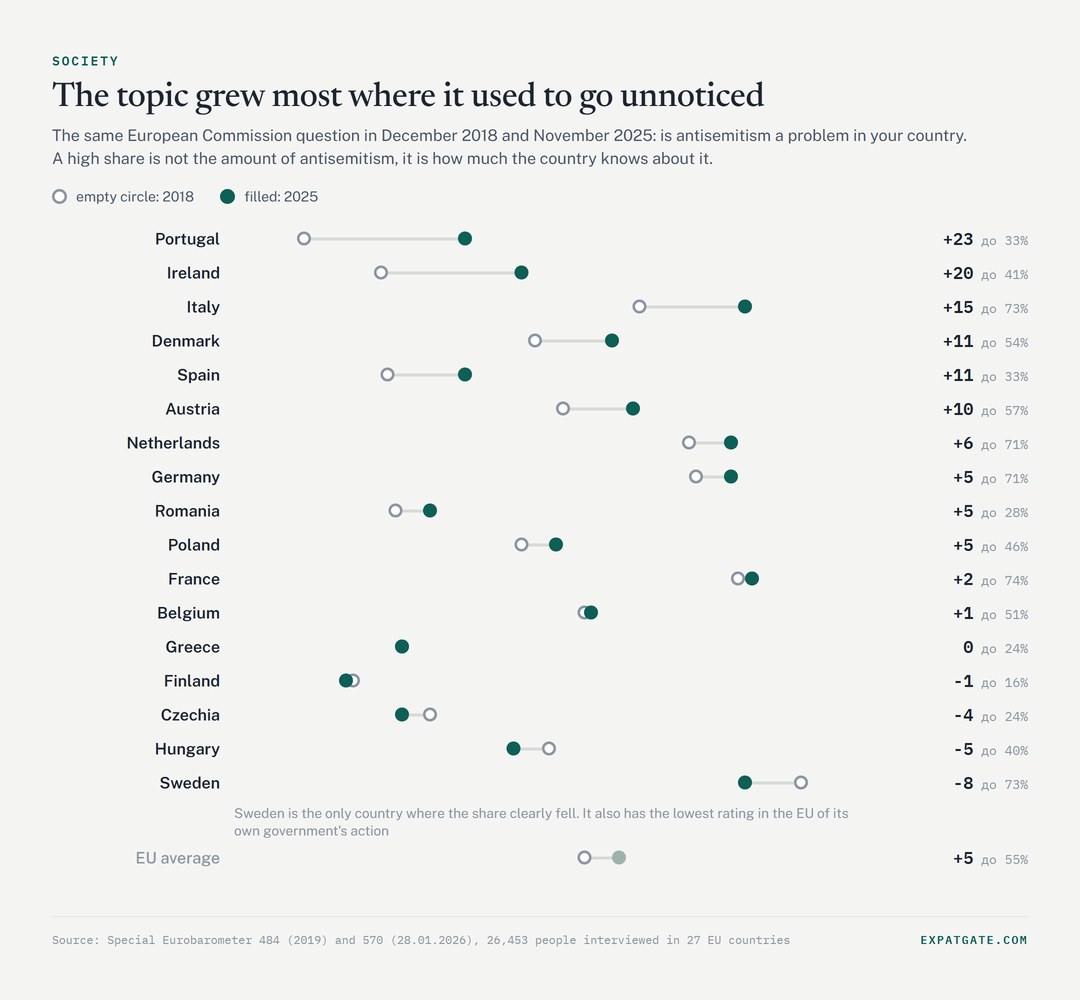
The only country with a noticeable fall is Sweden, minus 8. And Sweden also has the lowest rating in the EU of what its own state does. That is not a contradiction: society gets used to the topic faster than the state manages to answer it.
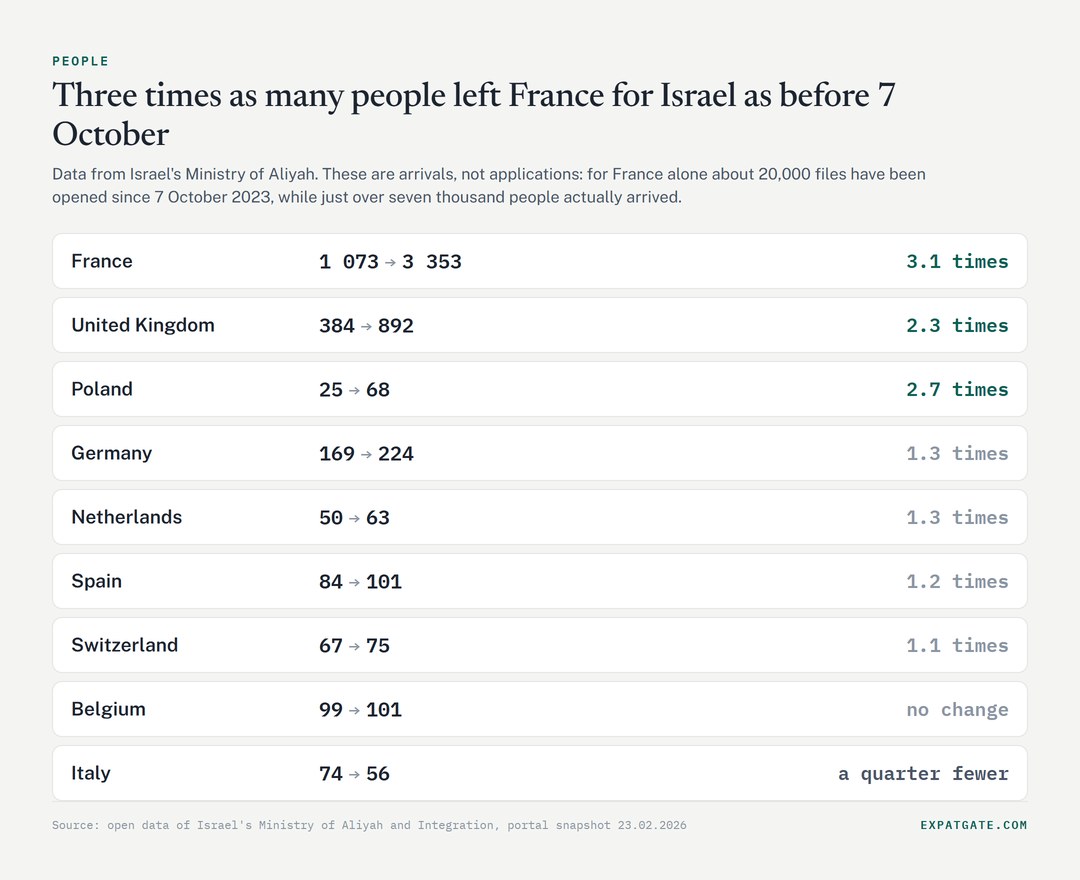
Moving to Israel is a decision people take not because of statistics but because of their own experience. From France 1,073 people left in 2023 and 3,353 in 2025, three times as many. From the United Kingdom 384 and 892. The figures are from the open data of the Israeli Ministry of Aliyah; the Jewish Agency and Israel's statistics bureau have their own counting systems, and their figures differ by tens of people.
But there are two limits. The French peak of 2015, 6,629 people, has still not been repeated. And three times more applications have been filed than moves that actually happened: people prepare an emergency exit, and not everyone uses it.
The test: one man with a "Support Hamas" placard
There is a well known way of comparing countries by one easily grasped object: the burger index. We made a test like that, only about protection. Picture one man with a "Support Hamas" placard who steps out onto the main street at midday. The question is simple: what happens next.
First, about what this test does not measure. It is not about attitudes to Gaza and not about the right to criticise the Israeli state. Hamas is an organisation the European Union has kept on its terrorist list in full since 12 September 2003. The question is narrow: does the state have a working instrument when an organisation like that is publicly supported on its street, and does it use that instrument. The test is good because the answer does not depend on an official's goodwill: it is visible in the articles of the law and in the cases of the courts.
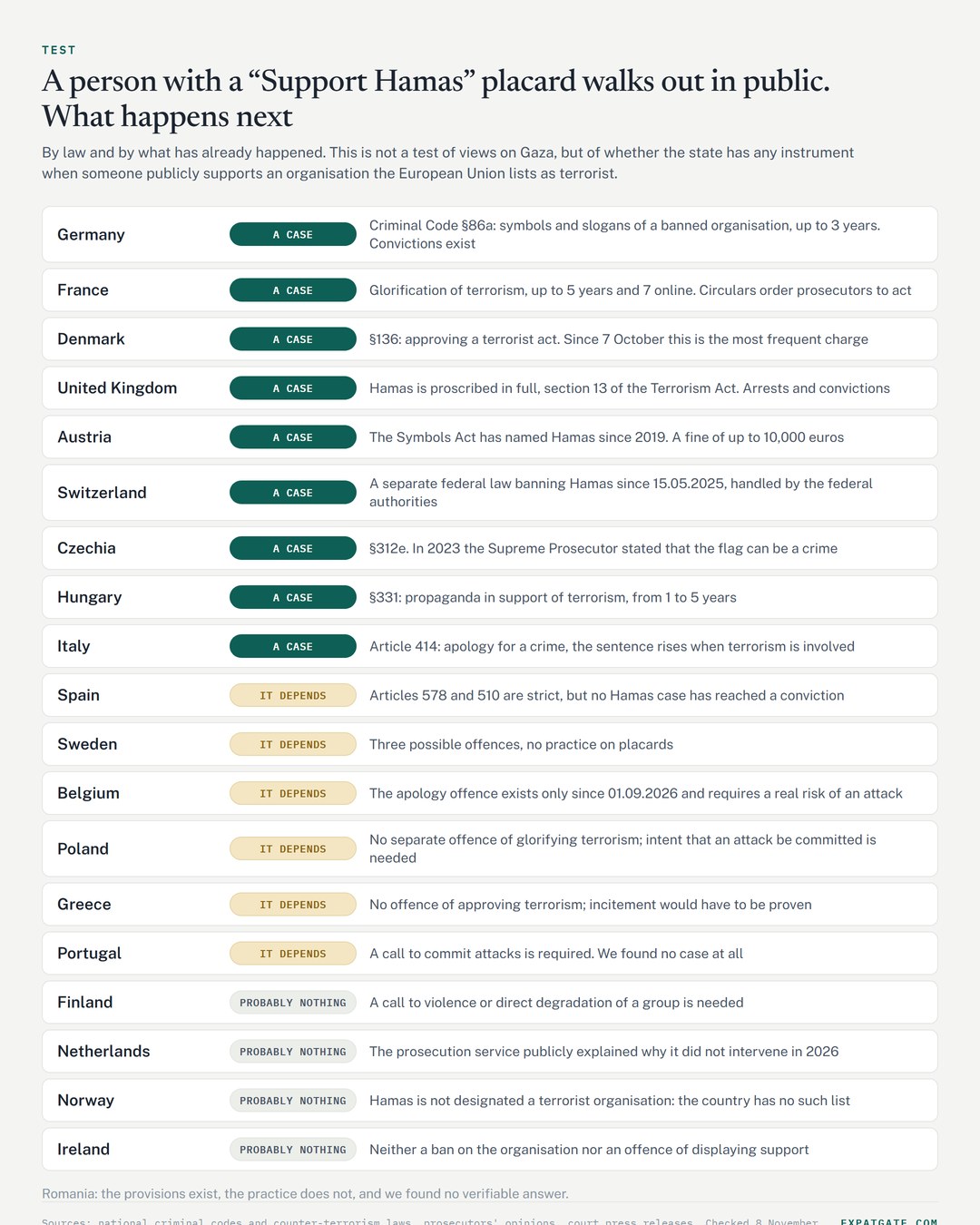
Nine countries where this is a criminal case
In Germany the flags, badges, uniforms, slogans and salutes of a banned organisation are named directly in §86a of the Criminal Code, with a penalty of up to three years, and the activity of Hamas has been banned in the country since 2 November 2023. There are convictions: on 18 December 2025 the Berlin regional court convicted a man for chanting at a demonstration together with posting the symbols.
In France it is article 421-2-5 of the Criminal Code, justification of terrorism: up to five years, up to seven if it was said online. Two circulars from justice ministers instructed prosecutors directly to open such cases, and the Paris prosecution service alone registered 386 reports in the six months after 7 October 2023.
In Denmark, after 7 October 2023, approving of a terrorist attack became the most frequent article inside the antisemitic police statistics. In the United Kingdom Hamas has been banned in full since 26 November 2021, and section 13 of the Terrorism Act punishes the mere wearing or display of an article arousing reasonable suspicion of support for a banned organisation; there are cases and convictions.
In Austria Hamas is named directly in the text of the Symbols Act from 1 March 2019; this is an administrative offence with a fine of up to 10 thousand euros, and where there is a call to terrorism a criminal article is added. Switzerland passed a separate federal law for this purpose.
In Czechia the Supreme Public Prosecutor's Office issued an opinion as early as 1 December 2023 saying directly that a Hamas flag at a demonstration may constitute an offence. In Hungary propaganda in support of terrorism before a wide public carries from one to five years. In Italy the article on apologia for a crime applies, and the term under it increases where terrorism is involved.
Six countries where everything depends on the circumstances
In Spain the articles are written harshly, glorifying terrorism carries from one to three years, and the hate crime article contains the word "antisemitas" (antisemitic) outright. But no case has reached a verdict specifically for supporting Hamas.
In Belgium a separate offence of apologia for terrorism only appeared on 1 September 2026, and its threshold is high: a serious and real risk of a terrorist attack is required. In Poland there is no separate article on apologia for terrorism at all, and the existing provision requires proving intent that a terrorist attack be committed. In Greece and Portugal a prosecutor would have to prove incitement rather than support. In Sweden there are three possible articles and not one case about placards that we know of.
Four countries where most likely nothing will happen
The Netherlands we have already gone through: the banner on Dam Square was found not to be punishable, and the bill has not been passed. The only working instrument there is administrative: a mayor can instruct organisers in advance not to display such a flag, and breaching the instruction is punishable as a minor offence. That is exactly what Amsterdam did on 15 October 2023.
In Norway it is simpler still: Hamas is not recognised there as a terrorist organisation, because the country has no national list, it is not in the EU, and the criminal law contains no list of organisations. In Ireland there is neither a ban on the organisation nor the British offence of displaying support. In Finland a call to violence or direct denigration of a group of people would be required.
The twentieth country is Romania, and for it we found no verifiable answer: law 157/2018 bans Legionary and fascist symbols, but we were unable to find any case or conviction over Hamas symbols.
What this test shows
First. The severity of the law and how protected people are lie on different axes, and that is no coincidence. A law against symbols is written fast and costs nothing, while a permanent post outside a school costs money every year. So a state can be strict on paper and stingy on the street, and the other way round.
Second. Where the state has no criminal instrument, it uses administration instead of law: it bans an event, prescribes a route, refuses entry, expels a foreign national. That is what happened in the Netherlands, in Hungary, in Greece, in Italy. It works faster but works worse: the decision is taken by an official rather than a court, and on its own citizens it often does not work at all.
Third. The countries that speak loudest about human rights and have gone furthest in criticising the Israeli state came out at the bottom of this test. That is not a reproach: free speech has a price, and Norway and Ireland pay it knowingly. But for someone choosing where to live, the difference between "the state can intervene" and "the state cannot intervene" is quite tangible, and it is better to know about it in advance.
If you are choosing a country: what to check before you move
These are the questions we put to the countries in this guide. They are worth putting to the city you are going to as well, because inside one country the difference is sometimes bigger than between countries.
- Whether the country has an organisation that keeps a count of incidents. If it does, it usually has a phone number, a reporting form and people who will answer in your language. If there is no such organisation (Portugal, Poland), there is nobody to expect help from on this front.
- Who guards the Jewish school and the synagogue in your city, and at whose expense. Ask the community directly. The answer "the state pays" and the answer "we raise it ourselves" mean a different quality of life and a different size of community levy.
- How things stand at school. The question is not about Jewish schools but about ordinary ones: does the country publish reports on incidents in schools, how does a school react, do parents move children to Jewish schools and are there any nearby.
- What the police say when people come to them. Ask in the community what people's experience of filing reports is and how those reports ended. That is the only way to learn what statistics do not show.
- Whether there is kosher food, a mikveh, a cemetery and the possibility of circumcision and shechita. In several European countries ritual slaughter is restricted or banned, and a ban on circumcision is discussed regularly; for an observant family this settles the question of the country.
- How visible you are. An unpleasant question, but everyone asks it of themselves: are you prepared to wear a kippah or a Star of David on the streets of this city. In the EU survey 76% of Jews said they at least sometimes avoid it.
- What is happening with the topic in politics. Look at who is in the government and the local council, what those people have said about Israel and about Jews, and how the country's Jewish community reacted to it. Your own view of Israeli policy has nothing to do with it: what matters is how the authorities behave when something happens to people.
And one last thing. No country in this guide gives a guarantee, and statistics describe last year rather than your next one. The most useful source is not a ranking and not a report but a conversation with two or three people from the community in the city you are going to. The communities are small, and conversations like that usually happen.
Frequently asked questions
Which country in Europe is safest for a Jew?
There is no such country in our data, and anyone who names one is simplifying something. Low risk and working protection in Europe almost never coincide: where there are few attacks there is usually no system to catch a rise, and where the system is expensive and effective the numbers are the highest in Europe. So we suggest not choosing a country by a single figure but going through the checklist above: who keeps the count, who pays to guard the school, what happens after a police report.
Does criticism of Israel count as antisemitism in these figures?
Sometimes yes, and we flag it every time. Most Jewish organisations count by the IHRA working definition, whose examples include denying Israel's right to exist and comparing Israeli policy with Nazi policy. So in some countries, Spain especially, statements by politicians and cartoons in newspapers end up in the community statistics. Where that is the case, we put the state figure next to it, which counts criminal cases only. Jewish organisations themselves draw the line: the Greek, Swedish and Swiss sources in our material note separately that harsh criticism of the Israeli government is not antisemitism.
Can you wear a kippah in the street?
In the EU survey 76% of Jews said they at least sometimes avoid wearing anything they could be recognised by, and that share has not changed since 2018. It is highest in Germany, France, Sweden and Denmark (above 80%) and lowest in Czechia, Hungary and Romania (52 to 54%). In the Netherlands it is 77%, and 49% never wear symbols at all, specifically for safety reasons. This is not a ban and not advice, it is a description of how people are already behaving.
Where do you report if something has happened?
First to the police, even if it feels pointless: without a report the case will get into neither the statistics nor a file. In parallel, to the Jewish organisation in your country that keeps a count: CST in the United Kingdom, SPCJ in France, RIAS in Germany, CIDI in the Netherlands, CDEC in Italy, IKG in Austria, AKVAH in Denmark, the FCJE observatory in Spain, the Federation of Jewish Communities in Czechia, JRCI in Ireland. In Belgium, Czechia, France, Greece, Hungary and the Netherlands there are official data sharing channels between such organisations and the state, which means a report really does get through.
Is this data current?
It is of mixed vintage, and that is worth knowing before you use the figures. Incident statistics are mostly for 2025, and for some countries for 2024, because reports come out with a delay. The survey of European Union Jews, though, which half the comparisons in this guide rest on (trust in the state, hiding symbols, thoughts of leaving), was collected from January to June 2023, that is, before 7 October 2023 and long before the events in Amsterdam. No more recent comparable survey exists in Europe, and that in itself is a measure of the attention the subject gets. The European Commission's survey of the population is current, November 2025. The legal part we checked as of 8 November 2026.
How often do you update this guide?
Every three months, and sooner if a new annual report comes out or a law is passed. We watch the Dutch bill on glorifying terrorism separately: if it passes, the answer in our test for the Netherlands will change. And Hungary separately, where the government changed in 2026.
One last thing
Let us go back to where we started. In one university, over one autumn, a student's suspension was lifted, a few days later the university itself went to the police about him, and a week after that it could not hold a lecture by Jewish students because not one hall could be kept secret. Not one conviction, not one law broken, not one person hurt.
And at the other end of the country the mayor of the country's largest city looks at a banner supporting Hamas by the National Monument, says "shocking and distasteful" and explains that she can do nothing.
That is what the question "is it safe here" is actually made of. Not of attack statistics, but of what happens when nobody has broken the law. Which is why in this guide we look not at the numbers but at the machinery: who counts, who pays, what reaches court, and whether the people it happened to believe the state. The numbers change every year. The machinery changes far more slowly, and it is the machinery you will be living with.
How we counted and what is not in this data
We took sources in this order: the statistics of police forces, prosecution services and the relevant agencies; the reports of the EU Agency for Fundamental Rights and the OSCE; the annual reports of countries' Jewish organisations; court decisions. The websites of activist groups on any side were not treated as sources. Every number in the text is tied to who counted it and for which year.
What we deliberately did not do. We did not line countries up in a ranking by number of incidents: the source of the data itself forbids that, because definitions and the completeness of recording differ from country to country. We did not add state and community figures together: they are different things. We did not call something antisemitism when only one side calls it that, without noting who counted it and by which definition. And we did not publish claims about named individuals without a source that can be trusted.
What is not in the data. There is no recent Europe wide survey of Jews after 7 October 2023. There are no statistics on convictions with an antisemitic motive almost anywhere: countries count cases, not outcomes. There are no security sums for a good half of the countries. There is no recognised index of "where Jews feel calmest": we checked, no such index exists, and the one sometimes cited we could not confirm.
This material is not legal advice and not a forecast. It describes the situation as of the date of checking.