You are about to work for yourself in another country: a small firm, freelance work, a workshop, a shop or a studio. You have already worked out the rent and the visa, but nobody can tell you how many months will pass between filing the papers and sending a client the first legal invoice, and the usual answer is “a couple of weeks, probably”. This piece is about where countries actually get stuck and what to ask before you move, rather than once you are already there.
Germany turned out to be the most gridlocked country in the world for starting a small business. Before a firm can legally begin work there, it takes 3,942 hours of mandatory procedures: almost 500 working days, or two years of one person's time. In France the same thing takes 223 hours. An eighteenfold difference, and it is not the difference between a rich country and a poor one: both are rich.
The figures come from the Index of Bureaucracy 2026 report, which compared 27 countries. The German hours break down like this: 2,400 of them are municipal permits, another 1,441 are identification and registration. And on the way out of business Germany runs up 10,147 hours, of which 9,130 are the mandatory year of waiting for creditors: time when the owner does nothing and can speed nothing up.
The interesting part begins where the news ends. Germany is the edge of the scale, and the useful knowledge lies in the middle: what these hours are actually made of, and which of them is worth checking if you are choosing a country and plan to work for yourself there.
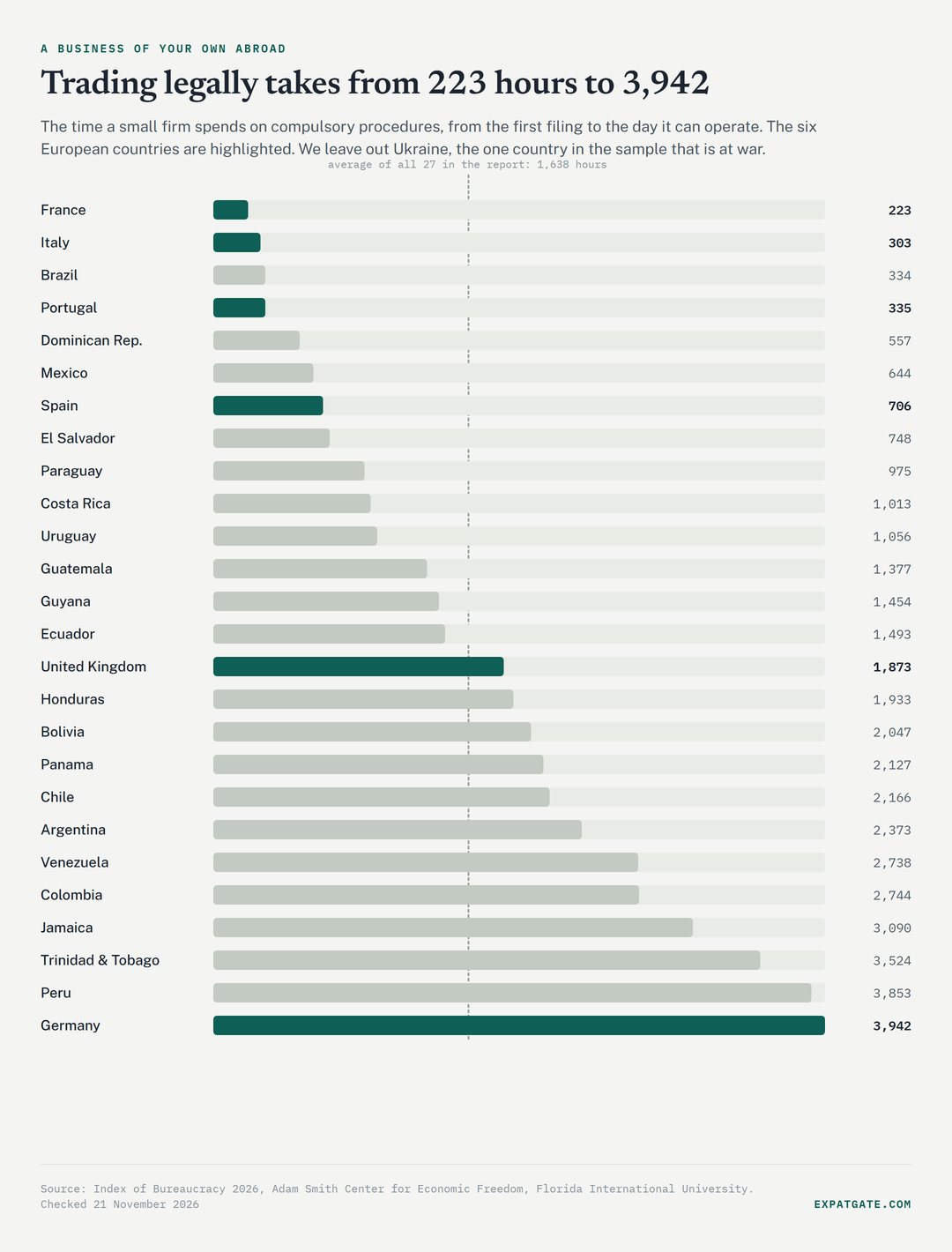
What the index showed besides Germany
Getting out of business takes longer than getting in. That is how it works in 16 countries out of 27, and on average across the sample the exit takes twice as long as the entry: 3,654 hours against 1,638. The Dominican Republic closes a firm 35 times slower than it opens one, Mexico 10 times slower, the United Kingdom and Brazil almost four times. People ask about the entry in advance; almost nobody asks about the exit, and the exit is exactly where the cost turns out to be highest.
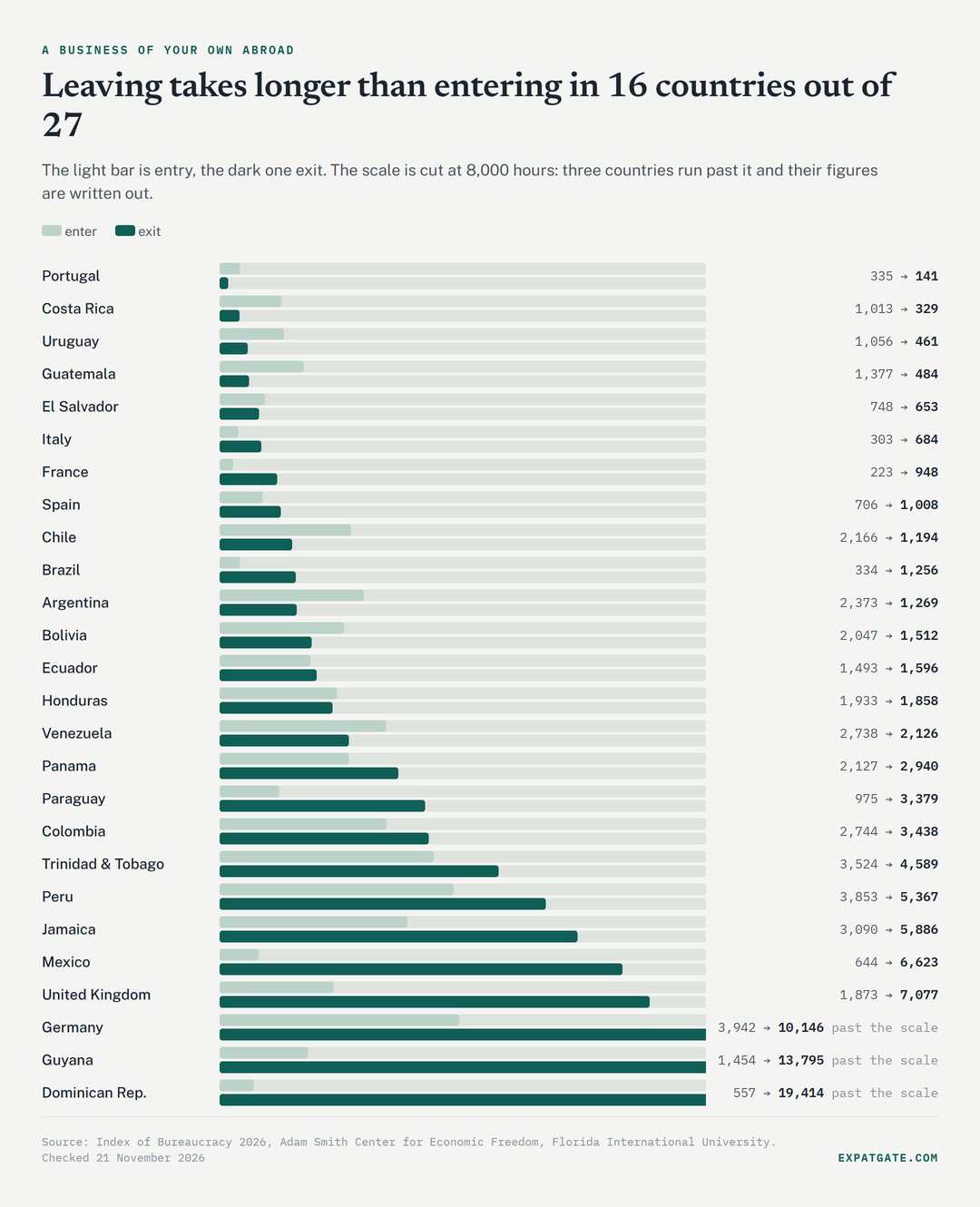
A firm is not a purchase, it is a subscription. On top of the one-off entry there is an annual bill: an average of 1,178 hours a year just to stay within the law. That is 57% of one person's working year. In seven countries of the sample the reporting does not physically fit into a single employee, so you need a separate person or a contractor.
Fast registration promises nothing. In the United Kingdom a firm is registered within a day through Companies House, and yet entry into business there takes 1,873 hours: 1,862 of them go on connecting basic services, above all a bank account. One of the owners interviewed for the report spent more than four months opening an account because of checks introduced after the 2008 crisis. Legally the firm was working from day one, but it could not take money for more than four months.
And this is the main conclusion, the one worth reading on for: countries get stuck in different places, and the place is almost never where you expect. In Spain a municipal permit takes one hour, while the notary and the registers take 377. In Portugal registration takes 11 hours, but a licence to use the premises takes 113 and a bank account 95. In Germany it is the other way round: municipal permits are the heaviest part of all.
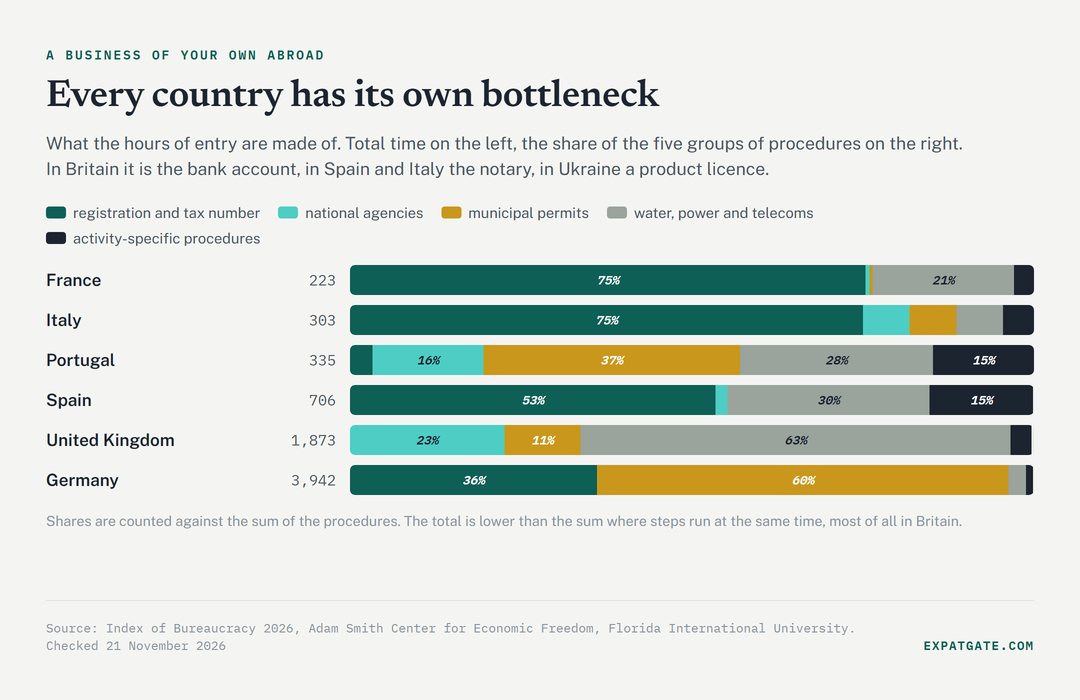
Which means the question “where is it faster to open a firm” is the wrong one. The right question sounds like this: what exactly will be my bottleneck in this country, and how much time will it eat before I start earning.
What to look at when you choose a country for your own business
Below are eight things worth finding out before the move rather than after. Each of them costs hundreds of hours in one or another of the 27 countries in the index, and each can be checked in advance with a single question to a local accountant, a lawyer or the owner of a similar business.
1. The gap between “the firm is registered” and “the firm can take money”
This is the most underrated point. Registration and being ready to work are two different events, and between them sits a bank account, and sometimes a licence as well. The British four-month wait for an account is one example, and the Portuguese 95 hours of customer checks is another. For someone moving country the gap is especially dangerous: if the residence permit requires turnover or paid contributions, the clock starts on the date of the visa, not on the date the bank finally opened the account.
What to ask: how many weeks it takes to open an account for a firm whose founder is a non-resident, and which banks are faster. Not “can an account be opened” but exactly how many weeks and at which bank.
2. The licence for your particular line of work
Procedures tied to the line of work are the main bottleneck of the whole sample: 706 hours on average, 43% of all entry time. And here the country average is useless: the same country opens a consultancy in a few dozen hours and a shop selling alcohol in a few hundred, because it is waiting for a licence. Your line of work may turn out to be the fastest in the country or the slowest.
What to ask: does my business need a licence or a permit on top of registration, who issues it and how long is the wait on average. And separately: can I work while I wait for it.
3. The municipality: the permit for your premises
Municipal procedures are the second heaviest group, 515 hours on average. The spread is enormous: one hour in Spain, 2,400 in Germany. And this is the case where the country does not decide everything: the rules and the speed are set by the particular city, and a move to the next one along can change the timeline.
What to ask: does the municipality have to permit the use of the premises for my line of work, how long does that take in this city and can I work legally before the permit is issued.
4. Annual reporting: how many hours and how much money
Entry happens once, reporting lasts forever, and countries swap places as soon as you look at several years. France opens a business in 223 hours, but costs 879 hours a year: one year in the life of a French firm is almost four times more expensive than starting it. Spain is the opposite: 707 hours to enter and 351 hours a year. The crossover comes in the first year already, and over five years the difference becomes decisive.
What to ask: how many hours a month go on mandatory reporting if there are no employees, and how much an accountant costs a month. Separately: what is included in that price and what counts as a separate service.
5. Whether you will have employees
This changes the picture more than the country does. In Italy the annual load on a firm is 546 hours, and 487 of them are payroll and pension reporting. In the United Kingdom the longest part of running a business is not tax but hiring checks: the right to work and criminal record certificates. If you work alone, your bill will be a completely different one, and country averages barely apply to you.
What to ask: how much will my reporting grow with the first hired employee, and what checks are required when hiring.
6. The price of leaving and the mandatory pauses
In most countries of the sample, the decision “I will try it, and if it does not work out I will close it” costs more than the entry. The worst part is not the volume of paperwork but the mandatory pauses, which cannot be shortened either with money or with a second pair of hands: the German year of waiting for creditors, the French steps that have to follow one another strictly in order. Until the business is closed, the reporting, the contributions and often the tax residency all remain, and that outlives the move to another country.
What to ask: how long does closing a firm take, is there a mandatory creditor waiting period and can a firm be closed if a trivial debt is left on the account. The last one is not a joke: the report calls it the “complexity trap”, where a company cannot be closed because the bank account will not close.
7. The surcharge that no index contains
All the hours quoted here were counted for a local small firm. A foreigner has more piled on top: legalisation and apostilling of documents, sworn translation, getting a tax number, proving legal status, and sometimes the requirement to already hold a work permit before registering the firm. Nobody has measured how long that takes: it is not in the index for any of the 27 countries. So read any hours from the tables as the lower limit for a local person, not as your own timeline.
What to ask: which documents need an apostille and a sworn translation, how long is the wait for a tax number and can a firm be registered before the residence permit is granted.
8. What happens to your residence permit if the business stops
The last point is the most important and the rarest in conversation. If the residence permit was issued for your business, then suspending or closing the firm is not only an accounting question but a question of your right to stay in the country. Sometimes the status stays valid until it expires, sometimes it is cancelled, sometimes you are given time to find another basis.
What to ask: what happens to my residence permit if the firm suspends its activity or closes before the permit expires.
Checklist: what to check before the move
We have gathered these questions into a single list. It is built so that you can take it to a local accountant or lawyer and come away with answers in weeks, hours and money rather than in generalities. Tick the items off as you find the answers.
And one more thing, if the country is not chosen yet. Two of our lists narrow the field faster than the hours of bureaucracy do: residency without a job offer (where status is granted without an invitation to work) and low tax countries for expats. And the ranking of 97 countries shows a third thing: how the state treats newcomers once they have arrived.
The checklist as one file
We will send a two-page PDF: twelve questions with room for the answers of three countries side by side, and a note on who to ask and what a real answer looks like.
We will also add you to our weekly letter, What changed this week: one e-mail on Mondays about the countries that changed their rules for newcomers. Unsubscribe in one click.
Common questions
Why my country is not in the index
Because this is not a selection of countries but a network of partner institutes built by the author of the study itself, the Adam Smith Center at Florida International University. The data in each country is collected by a local think tank, and a country enters the index when such a partner has been found there. Hence the line-up: 20 countries of Latin America and the Caribbean and seven European ones. The Netherlands, Poland, the Czech Republic, Georgia, Serbia, the UAE, Turkey, the United States and Canada are not there, and that says nothing about them, good or bad. The index averages cannot be carried over to those countries, because the hours are tied neither to income level nor to region.
Why Ukraine is not in the text
Ukraine is in the index, but we are leaving it out of the charts and the examples: the country is at war, and its figures describe a wartime economy rather than a place people choose to move to. The sample averages, though, stay as they are in the report, across all 27 countries.
Is it true that Germany is the worst of all
On entry, yes: 3,942 hours is last place out of 27. But a large part of the German figure on exit is calendar waiting rather than work: the mandatory year of waiting for creditors accounts for 9,130 hours out of 10,147. Comparing that with hours a person actually spends in queues needs an adjustment. And the main thing: Germany is one line out of twenty seven, and the bottlenecks in the other countries are entirely their own.
What was counted as hours
Any requirement of a public authority that would not exist, or would be milder, without regulation. The hours include waiting too, if you cannot move on without the document you are waiting for. So it is more accurate to read the figures as the calendar length of a procedure rather than as time spent at a desk.
Where to find the original source
On the site of the Adam Smith Center for Economic Freedom at Florida International University: the index page and the PDF of the first volume in English. It has sections on each of the 27 countries, and that is where the explanations sit, such as the one about the Portuguese premises licence.
How we counted and what these figures leave out
All the hours are taken from the Index of Bureaucracy 2026 report (the sixth edition) and its summary tables. The report is published by the Adam Smith Center for Economic Freedom at Florida International University, lead author Sary Levy-Carciente; the data in each country is collected by local partners and verified by business owners. The centre openly works on economic freedom and deregulation, and that is worth bearing in mind when reading its conclusions. We take the hours and the methodology from the report, leave the judgements to it and recalculate nothing.
What these figures leave out:
- Most of the countries our readers move to. The sample has 27 countries, and it was put together not by importance but by whether there was a partner in the country.
- Any split by the founder's citizenship: the procedures were counted for a local firm. Legalisation of documents, translation, the tax number and proof of status are not in the index.
- Self-employed people and freelancers without a legal entity: what is counted is a small company.
- Fees and charges, only time.
- One identical business: each country used its own typical industries and averaged three sectors weighted by their share of the economy.
And one more thing, important for reading the charts: the group totals add up to more than the country total, because some of the steps run in parallel and the report counts them once. Adding the groups up and presenting the sum as the total is not allowed.
We checked the report data on 21 November 2026 against the PDF of the first volume. Ukraine is not included in the charts and examples, for the reason given above.